
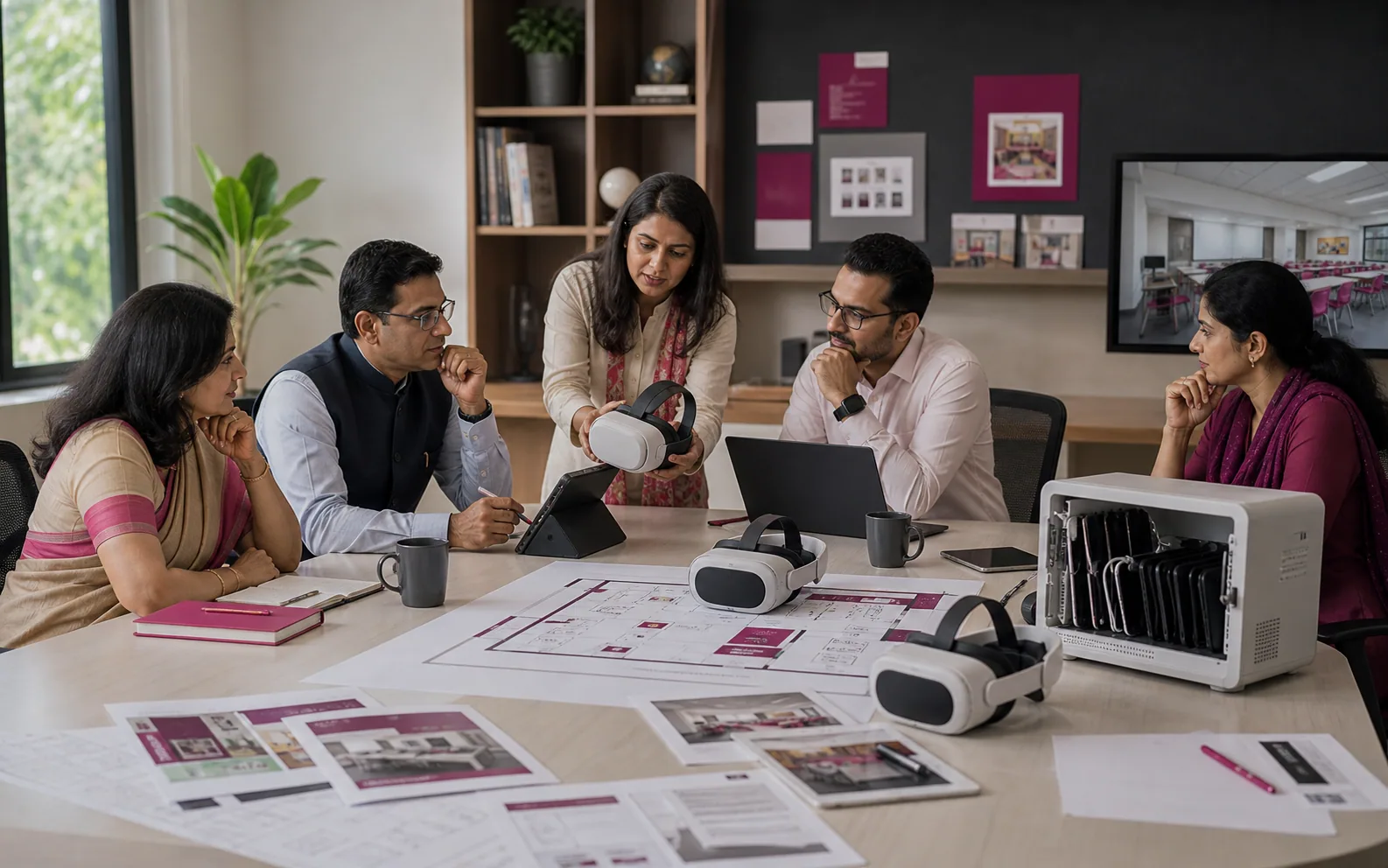
As of 14 September 2026, an Indian school should use roughly ₹2–6 lakh for an existing-device AR pilot, ₹6–12 lakh for a small shared-headset pilot, ₹14–24 lakh for a managed 12–15-headset lab, and ₹25–40 lakh for a 20–25-headset class set as initial planning ranges—not market averages or vendor quotations. The useful number is the five-year cost of running completed curriculum lessons, not the hardware total on page one of a proposal.
These bands are editorial planning scenarios built around the scopes described below. Prices change with devices, tax, exchange rates, licence terms and support. A quote that appears to fall inside a band can still be poor value if it excludes content renewal, device management, training or replacement cover.
This guide helps a school build and compare budgets. It does not report AiRedHQ purchasing experience, recommend a supplier or claim that these figures represent every Indian market offer.
Start the AR/VR lab cost estimate with four scenarios
The same phrase—“AR/VR lab”—can describe a few tablets used in groups or a turnkey room with a class set of headsets. Ask vendors to price the same teaching model before comparing totals.
| Planning scenario | Initial planning range | A workable scope | Usually excluded unless stated |
|---|---|---|---|
| Existing-device AR pilot | ₹2–6 lakh | Content for selected lessons, cases or a few additional tablets, basic charging, teacher training and pilot support | Major room work, custom content and multi-year renewals |
| Shared VR pilot | ₹6–12 lakh | 5–7 active headsets plus a spare, safe storage and charging, teacher control or casting, one year of selected content, training and support | Dedicated room fit-out and a device for every learner |
| Managed curriculum lab | ₹14–24 lakh | 12–15 active headsets, spares, management, storage, charging, casting, curriculum content, training, commissioning and defined support | Extensive civil work, custom simulations and indefinite licence renewal |
| Full-class set | ₹25–40 lakh | 20–25 active headsets, spares and the same operating components at larger scale | A guarantee that every subject or lesson will benefit |
These are budgeting allowances, dated 14 September 2026. They are deliberately broad because a defensible total depends on scope. Use them to decide whether a proposal is plausible and affordable enough to investigate—not to set a tender ceiling or declare a fair price.
A small pilot is normally the soundest starting point. Rotation can let six headsets serve a class while other groups complete related source analysis, modelling or discussion. Buying a full-class set removes rotation but raises replacement exposure, charging time and support demand. The school AR/VR lab setup guide compares these operating models and shows how to design the pilot before choosing devices.
Define what the price must deliver
A requirements-led budget starts with lessons, not a shopping list. Write down:
- the classes, subjects and two or three curriculum problems in scope;
- what learners must see, manipulate, practise or explain;
- how many learners will be immersed at once;
- how often the school expects to run each lesson;
- whether internet access is reliable enough for the proposed content;
- who will schedule, prepare, clean, update and troubleshoot the equipment;
- the equivalent route for a learner who cannot or should not use a headset;
- the evidence and date that will trigger a scale, redesign or stop decision.
This definition changes the bill. A short teacher-led AR activity on existing tablets may need content and preparation but no special room. A shared VR pilot needs storage, charging and a rotation plan. A full-class system needs stronger device management and faster in-lesson support because one failure can interrupt the whole class.
Public procurement documents show why totals cannot be compared without scope. A 2025 Government e-Marketplace contract recorded a bundled “Virtual Reality Classroom Set Up” at ₹24.94 lakh per unit, inclusive of tax, with equipment, content, furniture, training and five years of support in its specification. That is a historical contract, not a September 2026 market rate (GeM contract). A Rajasthan eBazaar proposal describes 25 headsets alongside curriculum content and other lab components, illustrating another bundled scope rather than a price that should be copied (Rajasthan eBazaar proposal).
Budget for the service around the devices
The headset line is easy to see. The labour and recurring commitments are where budgets often become unrealistic.
| Budget line | Questions the school should settle |
|---|---|
| Devices and spares | How many are active, how many are spares, and which accessories are included? |
| Content | Is it curriculum-mapped, licensed per device or site, usable offline, and renewable at what price? |
| Device management | Can staff deploy apps, restrict settings, monitor sessions and remove accounts centrally? |
| Teacher display and control | Can the teacher preview, cast, pause or guide the experience? What equipment is required? |
| Network and electrical work | Does the room need access points, extra sockets, electrical certification or bandwidth changes? |
| Storage, charging and hygiene | Are lockable storage, safe charging, replaceable face interfaces and cleaning supplies included? |
| Training and planning | Is training tied to actual lessons? Are refresher sessions and staff preparation time budgeted? |
| Support and warranty | What response and resolution times apply? Who pays carriage, parts and on-site visits? |
| Accessibility | Are captions, seated or reduced-motion modes, adjustable controls and equivalent alternatives available? |
| Replacement and exit | What happens to licences, accounts, student data, content and hardware at contract end? |
Room decoration is not a learning requirement. Branded panels, artificial flooring and elaborate furniture may make a launch look finished, but they should come after safe movement, ventilation, power, storage, supervision and lesson delivery. If the budget is tight, protect teacher time, support and good content before cosmetic fit-out.
Count staff time even when no invoice is raised. If teachers spend 50 hours mapping content and preparing lessons, or an IT coordinator spends two hours a week on the lab, the school is paying through workload. Leaving that work out makes an expensive model appear cheap.
Build three budgets, not one
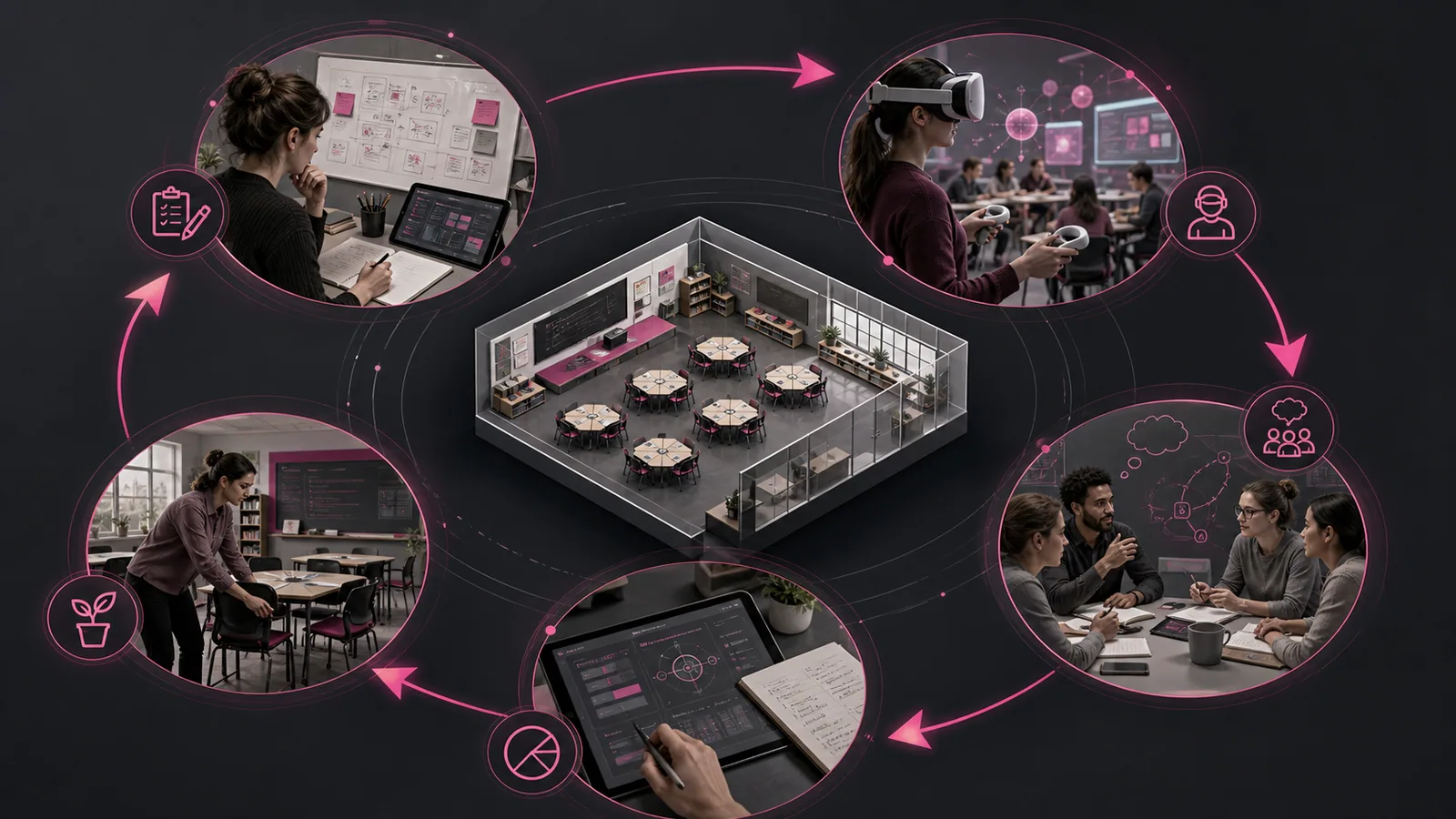
The purchase request should contain a capital budget, an annual operating budget and a five-year total-cost model.
Capital budget
Include devices, spares, controllers, protective accessories, storage, charging, casting, network or electrical changes, initial content, management setup, commissioning and initial training. Mark tax, freight and installation explicitly rather than assuming they are included.
Annual operating budget
Include licence and content renewals, device-management fees, support, consumables, replacement parts, refresher training, insurance where relevant and staff time. State which items can rise with device count, active users or inflation.
Replacement and exit budget
Reserve for battery degradation, damaged controllers, discontinued accessories and lost teaching capacity while devices are repaired. Also price data export or deletion, account closure, licence termination and responsible disposal. India's e-waste rules place duties on producers and registered recyclers; a school should ask for a documented take-back or authorised recycling route rather than treating obsolete headsets as general waste (E-Waste Management Rules, 2022).
Calculate five-year cost and cost per completed lesson
Use a simple model that anyone on the approval committee can inspect:
Five-year cost = initial purchase + renewals + support + staff time + consumables + expected replacements + exit costs
Then divide by use that actually happened:
Cost per completed curriculum lesson = five-year cost ÷ lessons successfully delivered to the planned class
“Successfully delivered” matters. A booking cancelled by failed logins or a content licence problem is not a completed lesson. Nor is an open-day demonstration. The denominator should include repeatable curriculum teaching, not registrations, catalogue titles or headset starts.
Consider a clearly illustrative managed-lab budget:
| Five-year item | Illustrative amount |
|---|---|
| Initial equipment, content, setup and training | ₹18,00,000 |
| Four years of content, management and support renewals | ₹8,00,000 |
| Staff planning and operational time | ₹4,00,000 |
| Consumables and expected replacements | ₹3,00,000 |
| Exit, data handling and disposal allowance | ₹50,000 |
| Five-year total | ₹33,50,000 |
If the lab completes 600 planned curriculum lessons in five years, the cost is about ₹5,583 per completed lesson. If timetable friction and failures reduce completion to 300, it doubles to about ₹11,167. The hardware did not become more expensive; weak utilisation did.
Track student participation separately. Cost per learner-session can help with capacity planning, but it can reward shallow five-minute turns. Cost per completed lesson keeps the budget connected to teaching. The companion guide to measuring AR/VR learning outcomes explains how to judge whether those lessons improve retention or transfer rather than enjoyment alone.
Normalise vendor quotes before choosing one
Put every proposal into one comparison sheet. If a field is blank, mark it “not included” or “not confirmed”; do not treat silence as inclusion.
| Comparison field | Normalised entry |
|---|---|
| Active devices and spares | Model, quantity, storage and usable classroom count |
| Tax and delivery | GST status, freight, installation and commissioning |
| Content rights | Subjects, grades, titles, language, offline use, device or site limit, licence years |
| Management and privacy | Management term, accounts required, data collected, hosting and deletion route |
| Training | Hours, participants, lesson-planning support, refresher training |
| Warranty and support | Term, coverage, response time, resolution time, loan device and exclusions |
| Renewals | Year-by-year content, management, support and escalation terms |
| Acceptance | Tests the school will run before sign-off and payment |
| Exit | Data export/deletion, licence effects, hardware use after expiry and disposal |
| Five-year total | Same assumptions, tax treatment and utilisation model for every vendor |
An initially cheaper quote can cost more. Suppose Quote A is ₹14 lakh with one year of content and support, then ₹2.5 lakh a year for four renewals, plus a ₹3 lakh replacement and exit allowance: five-year cost is ₹27 lakh. Quote B is ₹19 lakh with three years included, then ₹2 lakh a year for two renewals, plus the same ₹3 lakh allowance: five-year cost is ₹26 lakh. These figures are illustrative, but the comparison method is the point.
Do not accept “unlimited content” as a complete answer. Ask for the actual title list, curriculum version, languages, update policy and content that works on the quoted devices. Similarly, “three-year warranty” says little without response times, exclusions and the plan for a failed device during a scheduled lesson.
Put acceptance tests and payment gates in the order
A brochure demonstration is not acceptance. Before final payment, test the system in the room, on the school network and with the people who will operate it.
Useful acceptance tests include:
- Launch the agreed lessons on every active device and the spare.
- Run offline or restricted-network use if the proposal promises it.
- Cast or monitor a session from the teacher station.
- Enrol, restrict, update and reset devices through the management system.
- Complete one realistic class rotation, including cleaning and charging.
- Use the accessible or non-headset route for the same learning task.
- Log a support request and confirm escalation contacts.
- Verify the approved content list, licence dates, warranty records and administrator credentials.
Tie payment to supply, commissioning, acceptance and training milestones. Record who decides that each milestone has passed. A school is in a weaker position if it discovers unusable content or missing administrator access after paying the whole amount.
Watch for procurement red flags
Pause or ask for a revised proposal when:
- the product list comes before any curriculum or operating requirement;
- a price is called “per lab” but the number of active devices is unclear;
- GST, freight, installation or renewal charges are missing;
- the supplier counts a large catalogue but will not identify relevant lessons;
- the licence ends before the planned evaluation period;
- support promises use words such as “prompt” without response and resolution times;
- the school cannot centrally manage devices or retain administrator control;
- personal student accounts are required but the data purpose, retention and deletion terms are vague;
- custom content is promised without an acceptance process or ownership terms;
- utilisation forecasts assume every available period will run successfully;
- furniture and decoration consume money needed for training, spares or support;
- the vendor discourages a pilot or will not support a stop decision.
Privacy questions belong in the commercial comparison. India's Digital Personal Data Protection Rules, 2025 require clear notices and safeguards around personal data. Schools should identify what the headset, app, management console and analytics service collect; minimise learner accounts; define retention and deletion; and contractually assign responsibilities (Digital Personal Data Protection Rules, 2025). Obtain appropriate legal and procurement advice for the school's circumstances.
Choose a cheaper medium when it does the job
Immersion is worth paying for when a learner needs to judge scale, position objects in space, practise a sequence safely, revisit an inaccessible place or make decisions inside a responsive situation. It is usually poor value when the task is reading, watching a fixed explanation, recalling facts or discussing evidence that works just as well on paper, a shared screen or a physical model.
A ₹2–6 lakh AR or desktop-3D pilot may be a better decision than a ₹25–40 lakh class set if it answers the learning question with less support. A physical model may be better still because learners can see one another, point together and handle the real object. The correct comparison is not “premium VR versus basic VR.” It is VR versus the least complex method that enables the required learning action.
Before approving a purchase, the school should be able to state:
- which lessons will run in the first two terms;
- which teachers own them and how much preparation time they have;
- the five-year cost under the same assumptions used for competing quotes;
- the expected number of completed curriculum lessons;
- what learning evidence will justify the additional cost;
- what workload, reliability, access or safety result would trigger redesign;
- what conditions would make the school stop.
The responsible budget is not the lowest opening quote or the most impressive room. It is the smallest sustainable model that delivers a useful lesson, can be repeated by ordinary school staff and remains good value after renewals, failures and teacher time are counted.
Built from product experience