Staff questions answered from your documents
HR, compliance or product questions answered from approved handbooks and wikis, with a citation a reviewer can check.

AiRedHQ builds AI assistants, retrieval with citations (RAG), workflow automation and LLM integrations for startups, SaaS products and teams buried in documents. A typical project starts with a 2-week audit and ships a tested pilot in 4 to 6 weeks, with an evaluation set, human review and the cost per request measured.
hiARed
Job Post Quality
Senior Product Engineer
Read post
Check factors
Explain score
Recruiter approves
Salary range and role scope are clear. The post does not say how many interview rounds there are or when candidates hear back; adding both would raise the process score.
Move from an AI idea to a dependable product capability grounded in your workflow, data and users.
HR, compliance or product questions answered from approved handbooks and wikis, with a citation a reviewer can check.
Resumes, invoices, forms or contracts in PDF and DOCX read into structured fields. Low-confidence items go to a person.
Rate job posts, leads or applications against a rubric and show which factors raised or lowered the number.
Classify incoming tickets or emails, draft a reply, and let an agent approve or edit it before it is sent.
Teams that already have a workflow worth improving, and the documents or data to ground it.
Our work on hiARed informs how we design explainable AI workflows, human review and multi-role decision systems.
Task-focused assistants designed around real roles, permissions and business context.
Retrieval pipelines that give models relevant, governed and traceable context, with citations back to the source.
Human-aware automation for repetitive operational and knowledge workflows.
Model capabilities embedded into products with evaluation, safeguards and observability.
Concrete artifacts you keep, whoever builds the next version.
The workflow, users, success measure and the cost of a wrong answer, agreed before anything is built.
Real examples with expected answers, and the pass rate the system has to reach before it ships.
Versioned prompts and indexed sources, so every change can be traced, compared and rolled back.
Where people approve, correct or reject output. Corrections flow back into the evaluation set.
Model, token and infrastructure cost at your expected volume, with a cheaper fallback where one exists.
Quality, latency, cost and human-override rate tracked after launch, with alerts when they drift.
Map the workflow, the users and what a good answer looks like.
Output: Use-case brief
Audit sources, access rules and sensitive fields.
Output: Data map and access plan
Build a working slice against your real examples.
Output: Working prototype
Score outputs against the evaluation set and compare models.
Output: Evaluation report
Connect to your systems with review steps, permissions and logging.
Output: Production release
Track quality, cost and overrides, then tune prompts and retrieval.
Output: Monitoring dashboard
Most AI integration work falls into one of three patterns. Choosing the right one early saves months and keeps running costs predictable.
Choose retrieval-augmented generation when answers must come from your own documents and change as they change. Citations make every answer checkable, and new knowledge means re-indexing, not retraining.
Choose fine-tuning when you need a consistent format, tone or classification at high volume and have hundreds of good labelled examples. It does not reliably add new facts, so it is often paired with RAG.
Choose plain workflow automation when the steps are predictable. Many AI automation requests are cheaper and more reliable as rules, with a model used only at the messy step, such as reading a document.
Start small and keep going only if it is working. Durations are typical; the first conversation sets the real scope.
Typically 2 weeks
Review workflows and data, shortlist use cases, and estimate value, risk and running cost for each.
Typically 4–6 weeks
One use case built on your data, with an evaluation set and review screen, used by a small group.
Typically 8–16 weeks
Integration, permissions, monitoring and rollout to the wider team.
Monthly retainer
Evaluation runs, model upgrades, prompt and retrieval tuning, and new use cases.
We do not publish fixed prices because scope varies widely. These factors move cost and timeline most; an audit or discovery engagement turns them into a written estimate.
Picking a model before agreeing what a good answer looks like leaves nothing to test against.
Without real examples and a pass rate, every prompt change is a guess.
Full automation before the override rate is low turns small errors into customer-facing ones.
A pilot that is cheap at a hundred requests a day can be expensive at a hundred thousand.
We build and run software of our own. These are the parts that relate to this service.
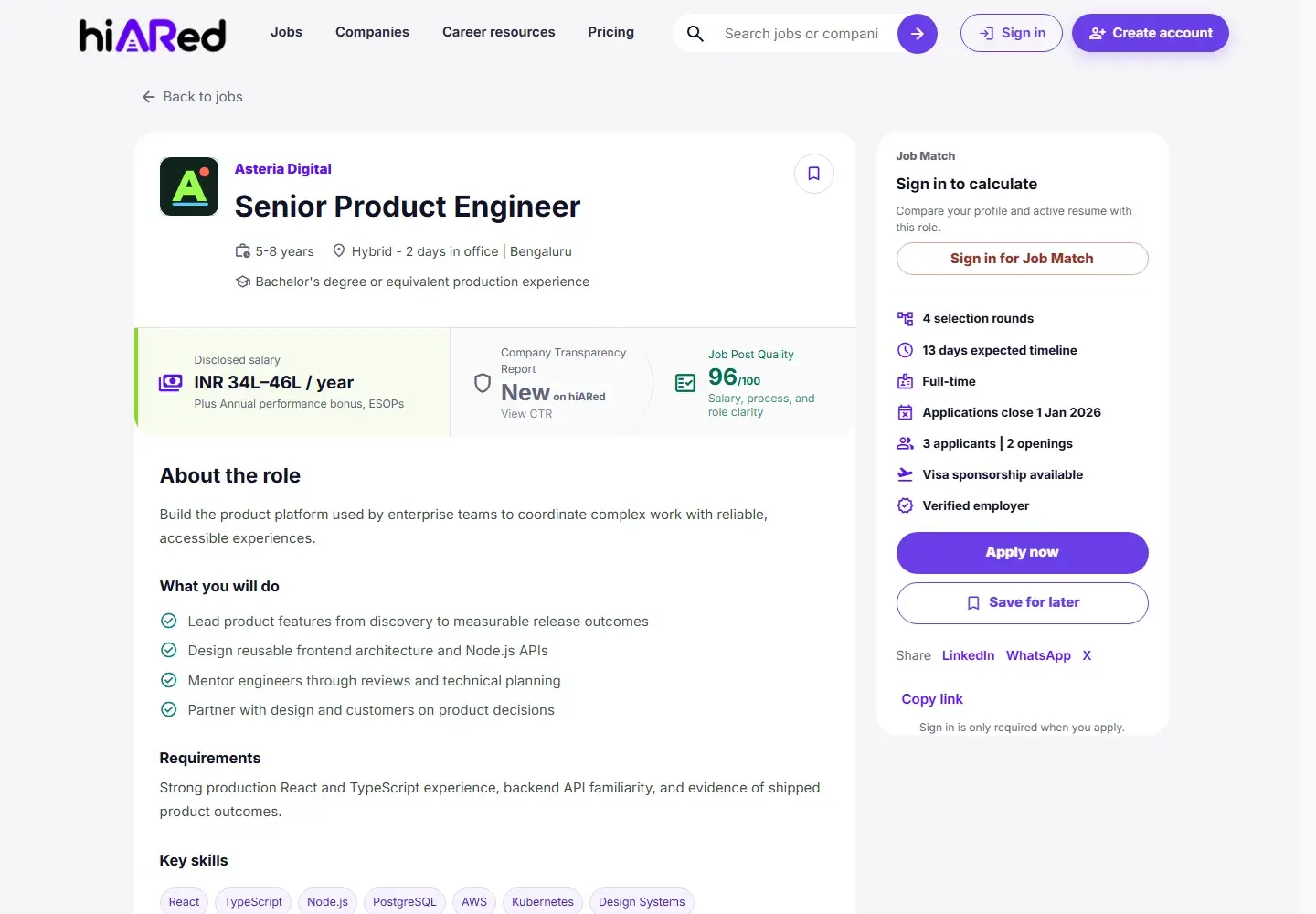
Every job post carries an explainable 0–100 Job Post Quality score, and every company a Company Transparency Report. Each score shows the factors behind it, such as salary, process and role clarity, instead of a bare number.
Resume parsing turns PDF and DOCX uploads into structured candidate profiles that recruiters review in the pipeline, with scorecards kept next to the evidence.
Model choice follows the workflow, data sensitivity and the cost of a wrong answer. We usually compare two or three models on your own examples before choosing.
 OpenAI
 Gemini
 LangChain
 Node.js
 PostgreSQL
 Redis
Updated
With a clear workflow, user need and success condition. Model selection follows those decisions. The two-week audit exists to get those answers in writing.
Yes. Architecture is shaped around access controls, data boundaries, retention and the sensitivity of the use case. Sensitive fields can be redacted before they reach a model, and providers are configured so your data is not used for training where they offer that option.
We combine grounded context, structured outputs, an evaluation set with pass thresholds, human review and monitoring, weighted by the risk of the workflow.
We test candidates such as OpenAI and Gemini models against your evaluation set and choose on accuracy, latency and cost. The integration stays model-agnostic so you can switch later.
You get a cost-per-request estimate during the pilot, based on real prompts and your expected volume. In production we set usage limits and alerts so spend cannot drift unnoticed.
Yes. AiRedHQ is based in India and builds AI into its own products, such as the explainable scores in hiARed, as well as for clients. You get working software to review every two weeks.
Usually not. A RAG assistant needs the documents it should answer from, and an evaluation set can start with 50 to 100 real questions and expected answers. Fine-tuning is the option that needs large labelled datasets.