
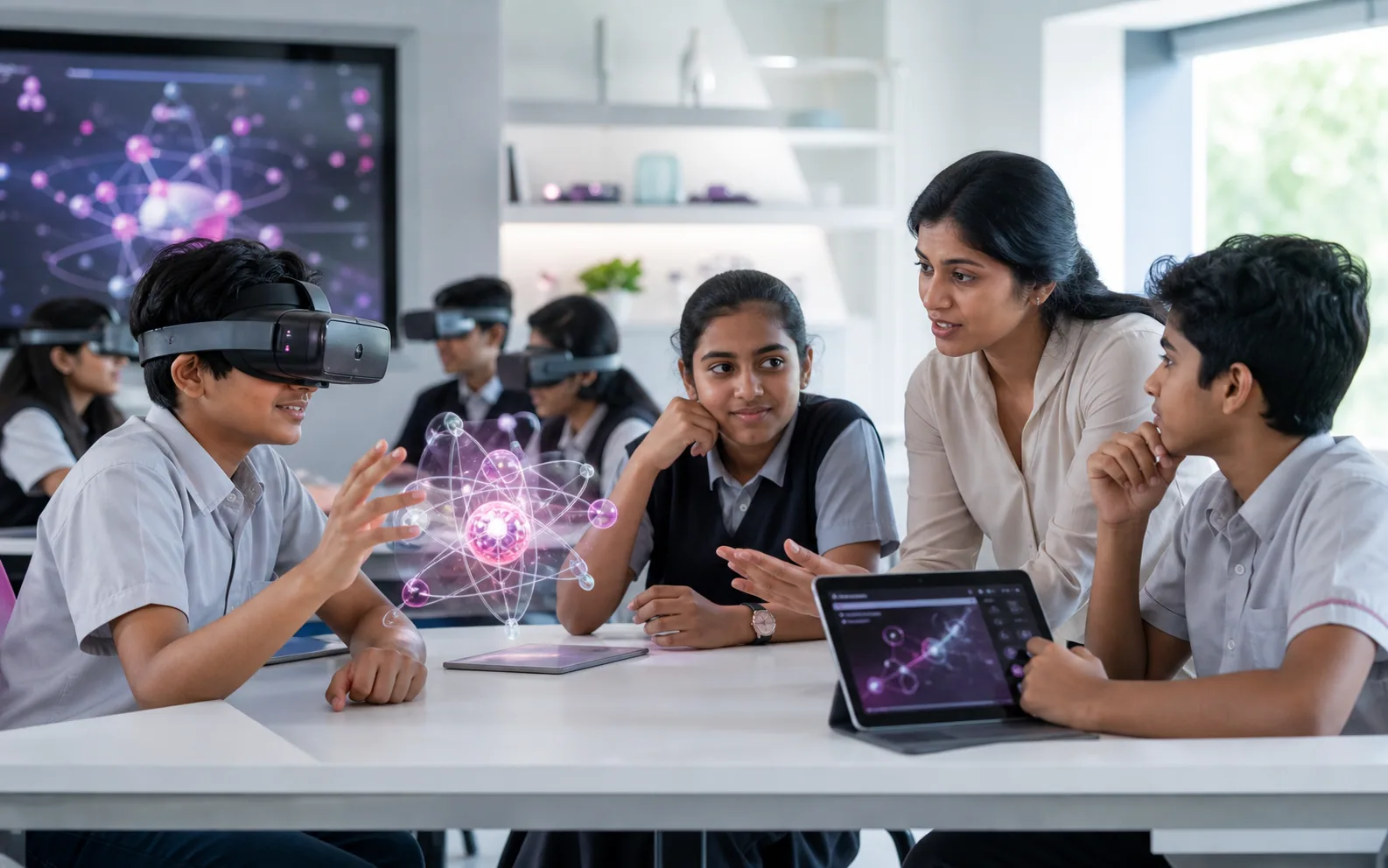
VR can improve learning when immersion enables a useful action—such as judging scale, manipulating a spatial model or rehearsing a procedure—and the lesson directs attention to that action. It does not improve learning simply by being immersive. High enjoyment is encouraging, but it is not evidence that students retained knowledge, transferred it to a new problem or learned enough to justify the workload.
Research offers reasons to test AR and VR, not a guarantee that a school should buy more headsets. Results vary by subject, learner, instructional design, comparison lesson and outcome measure. Some studies also compare a carefully designed immersive activity with a weaker conventional lesson, making it hard to know whether the medium or the teaching caused the difference.
This article translates that evidence into a school evaluation method. It does not report an AiRedHQ classroom trial or present the illustrative examples below as real results.
Define the VR learning outcome before evaluating the medium
Engagement, confidence and presence can support a lesson, but none is the same as learning. A student may enjoy exploring a virtual heart and still be unable to explain blood flow the following week.
Define the intended outcome before selecting the experience:
| Outcome | The practical question | A suitable measure |
|---|---|---|
| Engagement | Did students attend, persist and participate? | Observation, completion and a short learner response |
| Immediate understanding | Can they explain or apply the idea at the end of the lesson? | Explanation, diagram, worked problem or performance task |
| Retention | Can they still do it after novelty and short-term memory have faded? | A delayed task after a week or an appropriate interval |
| Transfer | Can they use the learning in a different example or real task? | Unfamiliar problem, new source, new model or practical demonstration |
| Spatial understanding | Can they reason about position, scale, structure or movement? | Predict, rotate, locate, construct or explain a spatial relationship |
| Procedural performance | Can they carry out the sequence accurately and safely? | Observed performance using the real or a sufficiently different system |
A quiz that asks learners to recall labels cannot establish procedural transfer. A satisfaction survey cannot establish retention. Match the measure to the claim.
The strongest school question is usually narrow: “Does this guided VR lesson help Grade 8 students explain the path of blood through the heart and lungs, and does that improvement remain one week later?” That can be tested. “Does VR transform science learning?” cannot.
What the research supports—and what it does not
The overall picture is promising but conditional.
A 2022 meta-analysis of immersive VR in K–12 education reported a small positive overall effect across 17 studies and 3,179 students. The authors also found substantial variation and cautioned that the result should not be treated as a universal effect (meta-analysis). In practical terms: an average positive result is a reason to run a focused trial, not a reason to assume every purchased experience will work.
Evidence can be stronger for a particular use. A 2025 meta-analysis of 22 experimental studies found a medium positive effect of AR on K–12 mathematics achievement, while also finding that how virtual objects were integrated affected results (AR mathematics meta-analysis). The relevant lesson for schools is not that “AR improves mathematics.” It is that an AR representation may help when its visual or spatial feature is integral to the mathematical task.
A systematic review of 117 K–12 STEM studies found reported advantages alongside distraction, discomfort, operational difficulty, classroom-management problems, teacher design demands, cost and infrastructure concerns. Nearly three-quarters of the reviewed studies had fewer than 100 participants, and most used non-immersive devices rather than head-mounted displays (K–12 STEM review). Do not turn findings from a small tablet-AR activity into certainty about a whole-class headset programme.
The sensible conclusion is specific:
- Spatial and situated tasks are plausible candidates. Immersion can expose relationships that are difficult to see on a flat page or place learners inside an otherwise inaccessible situation.
- Procedure rehearsal is plausible when the simulation requires the right decisions in the right order. Transfer to real equipment still needs testing.
- AR can be useful when a digital object must remain connected to a real object or shared space. A tablet may be enough; a headset is not automatically better.
- Factual recall alone rarely justifies the extra system. Retrieval practice, diagrams, models or video may achieve it with less cognitive and operational load.
Read comparative studies with care
When a study says the VR group performed better, ask what else differed.
A 2024 systematic review examined 50 VR-versus-conventional comparisons in STEM education. Only 26% were fully controlled on five important criteria, while 40% contained at least one difference in teaching method or content that could confuse the comparison (review of media comparisons).
In plain language, the VR group may have received an interactive, newly designed lesson with more practice and feedback, while the comparison group read text or watched a lecture. A higher score does not then prove that head-mounted immersion caused the gain. Active learning, feedback, time on task or better design may have done so—and those features may also work without VR.
Check whether:
- both groups learned the same content and had similar time;
- both received equivalent instructions, practice, feedback and teacher attention;
- the assessment tested the stated outcome rather than details unique to one lesson;
- students were assessed after a delay, not only immediately;
- transfer was tested outside the simulation;
- novelty, prior experience, discomfort and missing data were reported;
- the learners, subject and device are close enough to the school's situation.
This does not make the research useless. It changes the claim from “VR works” to “this combination of medium, activity and teaching may work for this outcome.” That is a more useful basis for lesson design.
Know when VR or AR is the wrong choice
Immersion is a poor choice when it adds sensation without adding a learning action. Warning signs include:
- students mostly watch a narrated sequence they could see clearly on a shared screen;
- decorative detail competes with the important relationship or instruction;
- controls and navigation consume more thought than the subject matter;
- the experience presents one polished reconstruction as unquestionable truth;
- game points reward speed or exploration but not the intended reasoning;
- a procedure can be completed in the simulation without the judgement needed on real equipment;
- students cannot pause, read labels, hear instructions or participate comfortably;
- the alternative route gives some learners a different or easier learning outcome;
- lesson time is regularly lost to setup, updates, logins or cleaning;
- the teacher cannot see what learners are doing or intervene effectively.
Sometimes the problem is the lesson, so redesign is worthwhile. Sometimes the medium is unnecessary. A physical model is often better for joint discussion; video is better for a fixed demonstration; desktop 3D may be better for precise group analysis; real practical work is better when it is safe, available and essential to competence.
Novelty deserves particular caution. Students may work harder because the experience is new. That is useful during the lesson but may not persist. Repeat the activity and measure after a delay before calling the effect sustainable.
Design the whole lesson, not the headset interval
Consider two history lessons about a virtual reconstruction.
In Lesson A, students enter the reconstruction, move around and answer recall questions about objects they saw. The experience may be memorable, but it treats a model assembled from evidence and inference as though it were the past itself.
In Lesson B, students first examine a primary source and predict what the reconstruction should show. During VR, they collect evidence about selected features and mark what appears documented, inferred or uncertain. Afterwards, they compare the model with another source and defend which interpretation is better supported.
The headset is identical. Lesson B is stronger because immersion serves source analysis rather than replacing it.
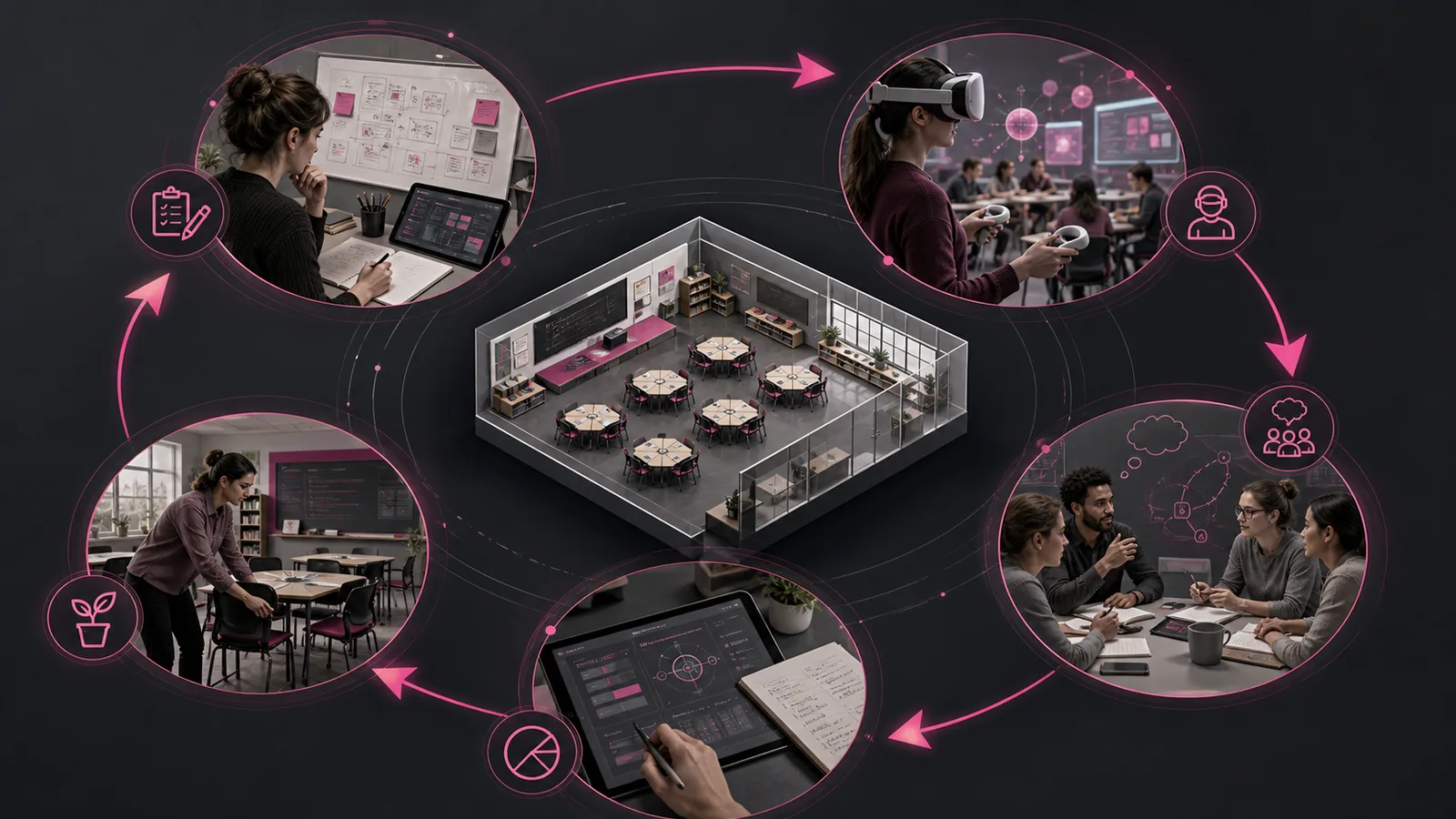
A repeatable lesson sequence is:
- Prepare: activate prior knowledge, teach controls and state the question.
- Predict: require a diagram, choice or explanation before immersion.
- Experience: direct attention with a short task rather than unrestricted exploration.
- Record: capture observations, decisions, errors or measurements.
- Reflect: explain what changed and separate evidence from impression.
- Transfer: apply the idea to a new case outside the immersive environment.
Keep headset time only as long as the learning action needs. Longer immersion can add discomfort, distraction and timetable pressure without improving the outcome. The school AR/VR implementation guide covers rotation, teacher and IT workload, safe operation, access and pilot design in detail.
Run a fair school evaluation
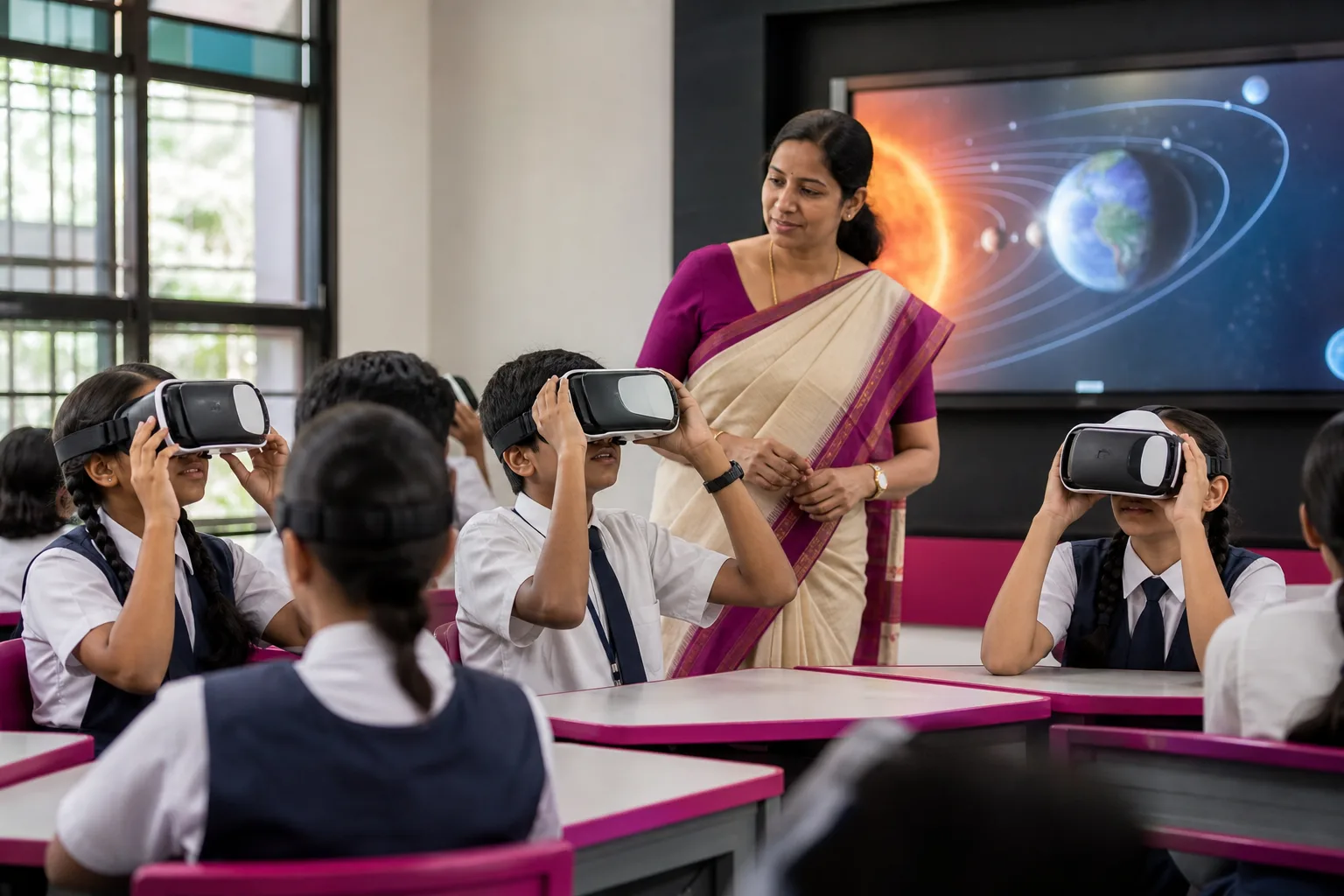
A school pilot is not a university experiment, but it can still produce decision-quality evidence.
Start with a written claim. For example:
After a guided VR heart lesson and debrief, Grade 8 students will explain the route of blood through the heart, lungs and body more accurately than after the current lesson, and the difference will remain one week later.
Then use this framework:
| Step | What to do | What it prevents |
|---|---|---|
| Baseline | Check the target knowledge or performance before either lesson | Mistaking an initially stronger class for a treatment effect |
| Fair comparison | Keep content, duration, practice, feedback and assessment as similar as practical | Crediting VR for better teaching conditions |
| Delivery record | Log actual minutes, device failures, opt-outs and deviations | Reporting the planned lesson instead of the one delivered |
| Immediate task | Test explanation or performance, not only recall | Calling recognition “understanding” |
| Delayed task | Repeat a comparable task after a suitable interval | Mistaking short-term memory or novelty for retention |
| Transfer task | Use a new example, representation or real procedure | Assuming success inside the app transfers elsewhere |
| Operations record | Count preparation, setup, support, cleaning and recovery time | Hiding the labour needed to repeat the lesson |
| Access check | Compare participation and outcomes through equivalent alternatives | Averaging away exclusion |
Use more than one class where possible, and repeat the lesson. A single enthusiastic teacher can prove that a lesson is possible; the school also needs to know whether another prepared teacher can run it. Do not overinterpret tiny score differences. Look for a result large and consistent enough to matter educationally.
The comparison should be the best realistic alternative, not an intentionally weak worksheet. If a physical heart model plus guided discussion is the school's normal strong lesson, compare against that. The question is whether immersion adds enough value over competent teaching to justify its burden.
Interpret mixed results honestly
The following examples are hypothetical. They show how the same pilot can support different decisions; they are not AiRedHQ or client results.
| Illustrative result | What it means | Sensible decision |
|---|---|---|
| Students rate the lesson highly, but immediate, delayed and transfer performance is much the same as the existing lesson | The experience is enjoyable; additional learning has not been shown | Do not scale for “engagement.” Try a clearer task or use the simpler medium |
| Immediate scores rise, but the difference disappears after a week and students cannot solve a new problem | The lesson may support short-term recall but not retention or transfer | Redesign the debrief, retrieval and transfer task, then test again |
| Delayed and transfer performance improve, but each class needs two hours of teacher preparation and one in five sessions is disrupted | There is a learning signal, but the operating model is not sustainable | Redesign support, content deployment or group rotation before buying more devices |
| Learning improves, workload is manageable, sessions are reliable and equivalent routes work for students who opt out | The school has evidence for this lesson under these conditions | Scale gradually to comparable lessons and keep monitoring |
Avoid two common reporting errors. “Students were 90% engaged” is meaningless unless engagement was defined and measured. “Scores improved by 20%” is incomplete without the baseline, comparison, assessment and number of learners.
Use cautious language that matches the evidence: “In this pilot, the guided VR lesson produced better delayed explanations than the current lesson” is defensible. “VR improves learning” is not.
Include workload, reliability and cost in the outcome
A lesson that produces a modest learning gain but depends on heroic teacher effort is not ready to scale. Track:
- teacher planning and content-review time;
- setup, distribution, cleaning and charging time;
- IT support and issue-resolution time;
- percentage of scheduled lessons completed as planned;
- devices ready at the start and failures during teaching;
- learner discomfort, opt-outs and use of alternatives;
- five-year cost and cost per completed curriculum lesson.
These are not distractions from educational evidence. They determine whether the learning result can survive ordinary timetables, staff turnover and competing priorities. The guide to AR/VR lab cost in India provides a five-year model and quotation comparison method.
Safety and access are also learning conditions. A student who feels unwell, cannot read an interface or receives a weaker alternative has not had the same opportunity to learn. Report those results rather than removing them from the analysis.
Scale, redesign or stop
Agree the decision rules before the pilot begins.
Scale a specific lesson or small group of similar lessons when the learning improvement is meaningful, remains after a delay or transfers as intended, teachers can repeat the lesson, sessions are reliable, participation is equitable and the added cost is justified.
Redesign when the learning idea is promising but attention, debriefing, assessment, access, content deployment, rotation or support is weak. Change one important element, state the new claim and test again.
Stop when immersion adds no useful action, the best simpler alternative performs as well, discomfort or exclusion cannot be resolved, content is inaccurate, learning does not survive novelty, or the operational burden remains unreasonable.
Stopping is a successful evaluation outcome when it prevents a larger commitment to a weak lesson. The aim is not to prove that VR belongs in school. It is to find the few places where immersion enables valuable learning and can be delivered reliably without hiding the cost in teacher labour.
Built from product experience