
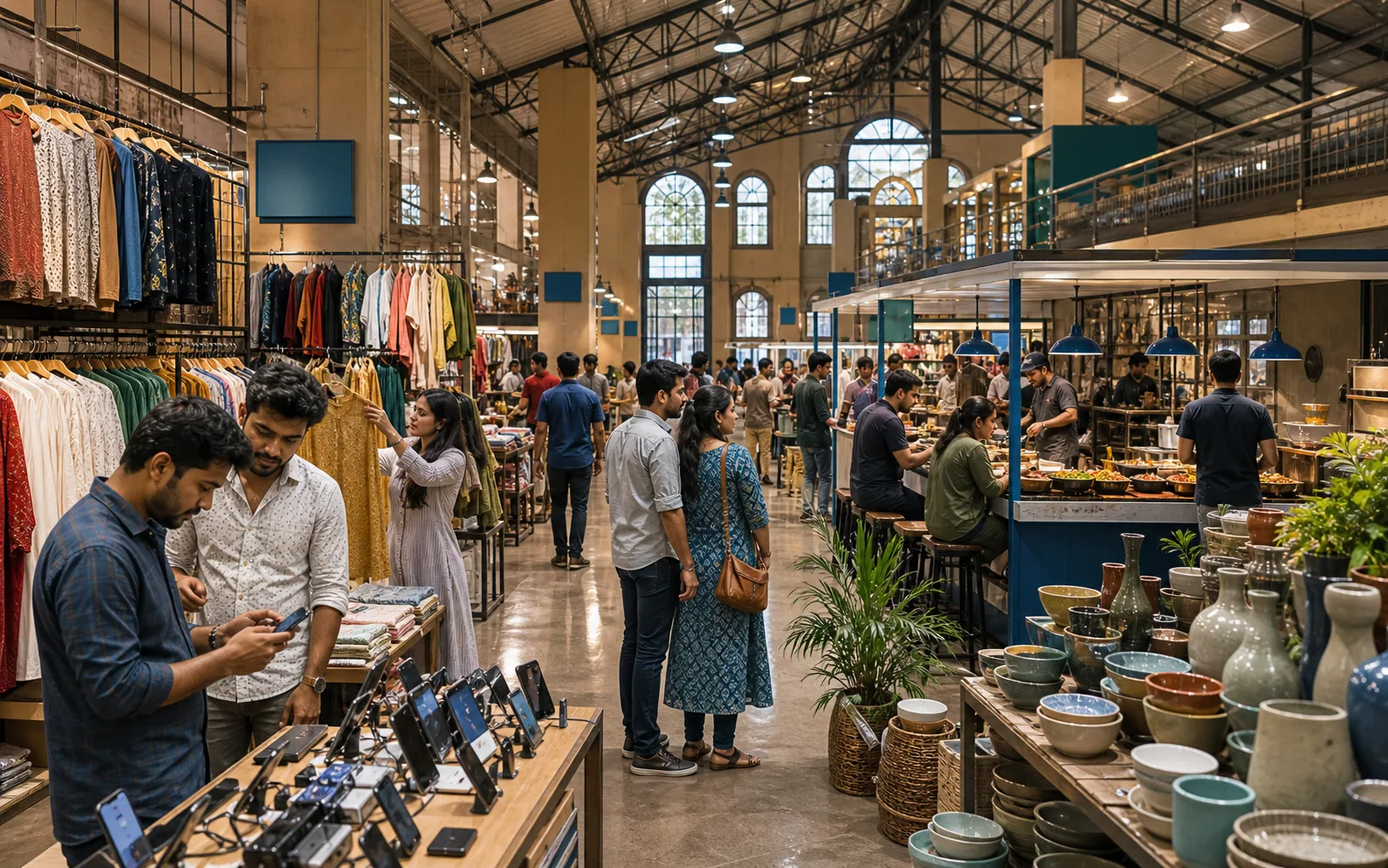
The nearest market is only the nearest pin. The best nearby option is the closest market that fits your purchase, is trading when you arrive and is practical to reach. A useful “near me” search must therefore combine location with category, time and travel mode.
This page will not name a market without knowing your location or claim to show live listings. It explains how to turn map and directory results into a shortlist you can verify. Once you know which markets you are considering, use the market-comparison framework for a deeper decision.
Translate “best market near me” into a real requirement
Start by replacing a broad query with the trip you actually need to make. Include:
- the item or market type;
- your starting area or landmark if location permission is unavailable;
- the day or “open now” requirement;
- retail or wholesale quantity;
- travel mode and acceptable journey time;
- a constraint such as invoice, accessibility, parking or delivery.
“Market near me” can return vegetable markets, shopping centres, wholesale yards and places whose names merely contain “market.” “Retail electronics market open Sunday within 40 minutes by metro” gives the search system—and you—a much clearer job.
Location permission is optional. A manual area, postcode, neighbourhood or landmark can be enough. Precise device location may improve distance calculations, but it should not be required just to read market information.
Build the first shortlist from several signals
Start with three to five plausible results, not the first pin. For each one, note the evidence behind four questions:
| Question | Useful signal |
|---|---|
| Does it fit? | Current descriptions and seller categories match the purchase |
| Can I get there? | Door-to-door route works for the intended mode and departure time |
| Will it be trading? | Day-specific hours or a recent direct confirmation exists |
| Is the trip proportionate? | Expected choice or saving justifies time, cost and uncertainty |
Google says its own local results mainly combine relevance, distance and prominence; it also notes that a farther result can rank higher when it appears more relevant (Google Business Profile guidance). That explains why search order is not a pure distance list. It does not prove that the first result suits your purchase.
Look across the business profile, official market or association page where one exists, recent user-contributed information and current route data. Agreement increases confidence; disagreement is a reason to verify, not average the claims.

Compare travel time, not straight-line distance
Distance ignores street layout, traffic, transfers, station exits, walking conditions and the load you will carry home. Compare the route at roughly the time you plan to leave.
Check:
- total duration and number of transfers;
- final walk from the stop or parking area;
- expected traffic or crowding;
- return transport after the market's busy period;
- whether bulky purchases require delivery or a pickup point.
An illustrative choice: a market 3 km away takes 45 minutes by two buses, while one 8 km away takes 28 minutes on a direct metro route. The second is “nearer” for this trip. If you are carrying furniture rather than a small bag, that answer may reverse.
Do not let an app silently choose a travel mode. A ranking that assumes driving can be useless to a person walking or using public transport.
Treat “open now” as a time-sensitive claim
“Open now” should be calculated from current hours in the market's local timezone, including special-day changes. A business marked operational may still be closed at the moment; individual sellers may follow a different schedule from the wider market.
Google's Places documentation distinguishes regular opening hours, current opening hours for the next seven days, special days and business status (Places API reference). Even then, a data field is not a guarantee that every stall is open.
Before a time-sensitive or long journey:
- Check when the hours were updated or which source supplied them.
- Look for a weekly closure or category-specific trading period.
- Confirm directly when the purchase is important.
- Keep a fallback market or ordinary shop in the same area.
An honest result can say “hours unconfirmed.” False certainty is worse than an extra phone call.

Match the market to the category
A large general market may have many listings and still be a poor destination for one specialist item. Search for the seller cluster or product language used locally, including common transliterations where relevant.
For clothes, distinguish ready-made retail, wholesale garments, fabric, tailoring and wedding wear. For food, distinguish fresh produce, wholesale ingredients, street food and packaged speciality goods. For electronics, distinguish authorised retail, components, repairs, refurbished devices and imported stock. For home products, distinguish finished furniture, custom fabrication, hardware, appliances and décor.
Do not combine these into a permanent city ranking. Product availability, seller mix and operating patterns change. The useful answer is category-specific and dated.
Make one short confirmation before leaving
Call or message a relevant seller, venue office or association using the contact route you independently verified. Ask only what changes the journey:
“I am looking for two retail ceiling fans with invoices, not wholesale cartons. Are several electrical shops trading tomorrow between 11 am and 2 pm, and which entrance is closest to the metro?”
This is an illustrative script. It checks category, quantity, timing and access without asking a seller to guarantee every business in the market.
If the contact demands an advance payment merely to confirm stock, moves the conversation to an unrelated number, or pressures you to act before providing written terms, pause. The guide to checking a local business before payment explains the proportionate next checks.

Know what a “near me” result cannot establish
A map pin cannot prove product quality, fair pricing, professional competence or safe service. A verification badge may confirm only identity or profile control. Reviews describe individual experiences and can be old, irrelevant or manipulated.
Likewise, an AI-generated summary can join incompatible facts or present an old opening time as current. Use generated recommendations to discover candidates, then inspect the underlying place, route and source information. The article on AI-powered local discovery explains what a responsible system should reveal.
Static articles also cannot truthfully satisfy a live “near me” query without your location and maintained place data. A page that lists the same supposedly nearby markets for every reader is not local discovery; it is a generic directory wearing a location phrase.
Choose a market—and keep a fallback
Choose the market that clears four tests: it fits the purchase, its schedule is recent enough for the trip, the route works in both directions, and the remaining uncertainty is acceptable for the value involved.
If two markets are close, prefer the one with better current evidence rather than the one with the louder “best” claim. If none clears the tests, use a known local shop, delay the trip or broaden the search area. “No reliable match yet” is a valid result.

Built from product experience