
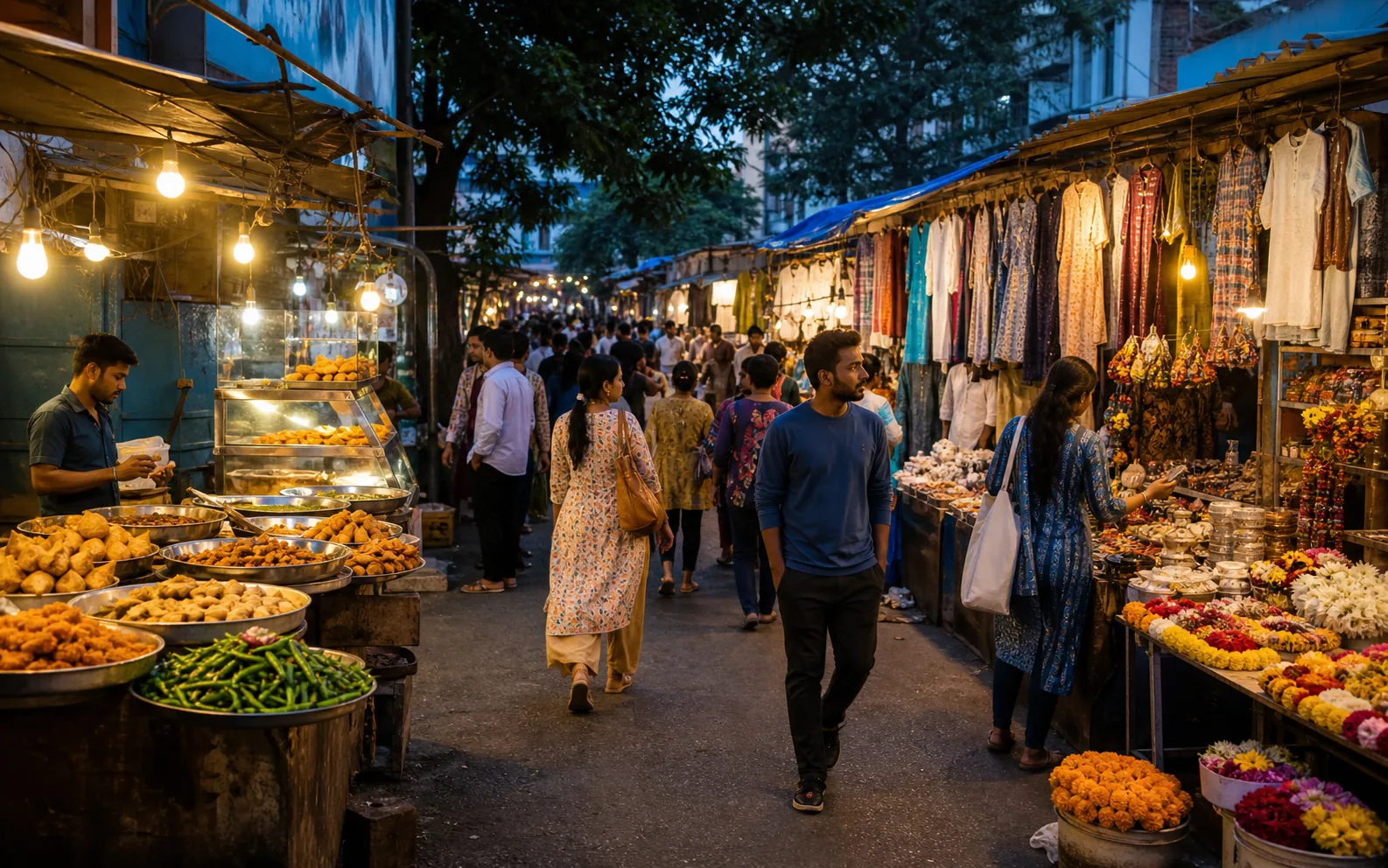
A famous market is not automatically the right market for your purchase. Before travelling, check whether it specialises in what you need, trades at the time you can visit, serves retail buyers, and offers enough buying protection for the value and risk involved.
This article is for comparing a market you already know by name with one or two alternatives. It does not rank markets in a city or claim that static information is live. If you still need to discover candidates around your location, start with the nearby-market search workflow.
Compare local markets by starting with the purchase
“Best market” only makes sense after the job is defined. A wholesale textile district may be excellent for a shopkeeper buying 100 units and frustrating for someone who needs one exchangeable shirt. A weekend craft bazaar and a daily produce market cannot be compared on the same terms.
Write down five things before searching:
- what you need and the acceptable alternatives;
- retail quantity, bulk quantity or made-to-order work;
- the total budget, including travel and delivery;
- the day and time you can go;
- any non-negotiable need such as an invoice, warranty, step-free access or public transport.
This prevents popularity, a low advertised price or a short straight-line distance from deciding the trip for you.
Compare the evidence that changes the decision
Use the same questions for every candidate market. Unknown information should remain unknown; do not turn an old review or undated directory entry into a fact.
| Decision factor | What useful evidence looks like | What can mislead |
|---|---|---|
| Speciality | Several current sellers and sources describe the same product cluster | “Everything available” with no seller or product detail |
| Buyer type | Retail, wholesale, trade-only or mixed is stated clearly | A low unit price that requires a large minimum order |
| Trading pattern | Day-specific hours, weekly closure and recent confirmation | A generic “open daily” label copied across listings |
| Seller choice | Enough relevant sellers to compare condition, terms and price | A market's total shop count, regardless of category |
| Buying protection | Written quote, invoice, test or inspection, return and warranty terms | Verbal assurances that change after payment |
| Trip effort | Door-to-door time, final walking route, parking and carrying plan | Distance alone |
| Access | Surface, steps, crowding, toilets, rest points and practical assistance | A general accessibility badge with no detail |
A market does not have to win every row. The point is to expose the trade-off. A specialist market farther away may be worth the trip for a consequential purchase; a nearby mixed market may be better for an ordinary replacement.
Verify the trading schedule close to the visit
Market timing is often a pattern rather than one opening-hours field. The market may be accessible while the relevant lane is quiet, wholesalers may finish before retail activity peaks, and individual shops may keep different weekly closures.
Check the date attached to the information. Google's current Places data distinguishes regular hours from current hours that incorporate special days, and it treats “operational” as different from “open now” (Google Places fields). That distinction is useful even if you use another source: existence, normal schedule and current availability are three separate facts.
For an important trip, confirm with a relevant seller, market association or official venue channel on the day. Ask a precise question: “Will the electrical-components shops be trading between 11 am and 1 pm tomorrow?” is more useful than “Is the market open?”
Treat festival periods, weather disruption, elections, public works and strikes as exceptions requiring a fresh check. If nobody can confirm, decide whether the likely value of the trip justifies that uncertainty.

Understand who the market is designed to serve
Retail markets normally sell individual quantities and are more likely to support browsing, exchanges and consumer packaging. Wholesale markets optimise for repeat trade, larger quantities and early operating hours. Mixed markets contain both, but the useful sellers and timings may differ.
Before travelling to a wholesale area, ask:
- Is the displayed price per item, pack, carton, kilogram or minimum lot?
- Can an individual consumer buy there?
- Does the quote include GST, delivery, fitting or alteration?
- Can colours, sizes or models be mixed within the minimum quantity?
- What happens if part of a batch is damaged or incorrect?
Wholesale is not automatically cheaper after minimum quantities, transport, breakage and unusable stock are counted. For a small purchase, a higher retail price with a clear exchange route may cost less overall.

Calculate the cost of the whole trip
Compare door-to-door effort at the time you intend to travel. A market six kilometres away may require two changes and a long walk; another twelve kilometres away may sit beside a direct metro line.
Google's Routes API, for example, separates route distance from duration and can calculate driving, walking, cycling, two-wheeler and transit routes (Google Routes documentation). A consumer does not need that API to use the principle: check the actual route, mode and departure time rather than reading the kilometre label as travel effort.
For an illustrative comparison, suppose Market A requires ₹160 in fares and 150 minutes of total travel, while Market B requires ₹60 and 70 minutes. A ₹120 saving on the item does not make Market A cheaper once travel is included. The answer can reverse for a larger order or a specialist item unavailable at Market B.
Also plan the last part of the trip. Check the walking entrance, safe pickup point, load you can carry and delivery terms. Parking beside a pin is not evidence that parking is available or practical.
Match verification to the purchase risk
Buying vegetables and ordering custom furniture do not require the same investigation. Increase verification when the payment is larger, delivery happens later, product condition is hard to inspect, or failure could affect health, safety or essential services.
| Purchase | Sensible market-level check | Seller-level check before payment |
|---|---|---|
| Everyday produce | Trading day, freshness pattern and transport home | Inspect goods and confirm price unit |
| Clothing | Seller range, changing facilities and alteration options | Fabric, finish, size and exchange terms |
| Electronics | Whether authorised and independent sellers are clearly distinguishable | Model, serial number, condition, invoice and warranty provider |
| Custom furniture | Relevant makers, material options and delivery reach | Drawing, dimensions, material specification, milestones and written remedy |
| Jewellery | Seller choice and whether required hallmarking support is available | Invoice, weight, purity details and HUID verification where applicable |
The market's reputation cannot replace checking the seller. For higher-risk purchases, use the separate guide to verifying a local business before paying.

Use a small shortlist, not a universal score
A single “best market” score hides why one option suits a particular visit. Use a simple shortlist with notes instead:
| Market | Fit for this purchase | Schedule confidence | Trip effort | Buying protection | Main uncertainty |
|---|---|---|---|---|---|
| Market A | Strong specialist range | Confirmed yesterday | High | Varies by seller | Returns |
| Market B | Adequate range | Official hours, not called | Low | Several invoicing sellers | Stock depth |
| Market C | Unknown | Old directory entry | Medium | Unknown | Too little current evidence |
This example is illustrative. It deliberately does not add the columns into a magic score. Market A might be right for comparison shopping; Market B might be right for a quick purchase; Market C needs more research before it deserves the journey.
After visiting, record what you actually learned: useful entrance, real trading hours, sellers compared, payment or delivery conditions, and what needs rechecking next time. Do not publish private details or present one visit as proof that every seller is reliable.
Decide whether the trip is worth making
Go when the market has a clear advantage for your specific purchase and the important uncertainties can be checked. Choose a simpler local alternative when the expected saving or product range does not justify the travel, crowding or transaction risk. Delay the visit when operating status, stock or seller terms are too uncertain for a consequential purchase.
The best comparison does not produce a famous winner. It produces an honest reason to visit—or a good reason not to.

Built from product experience