
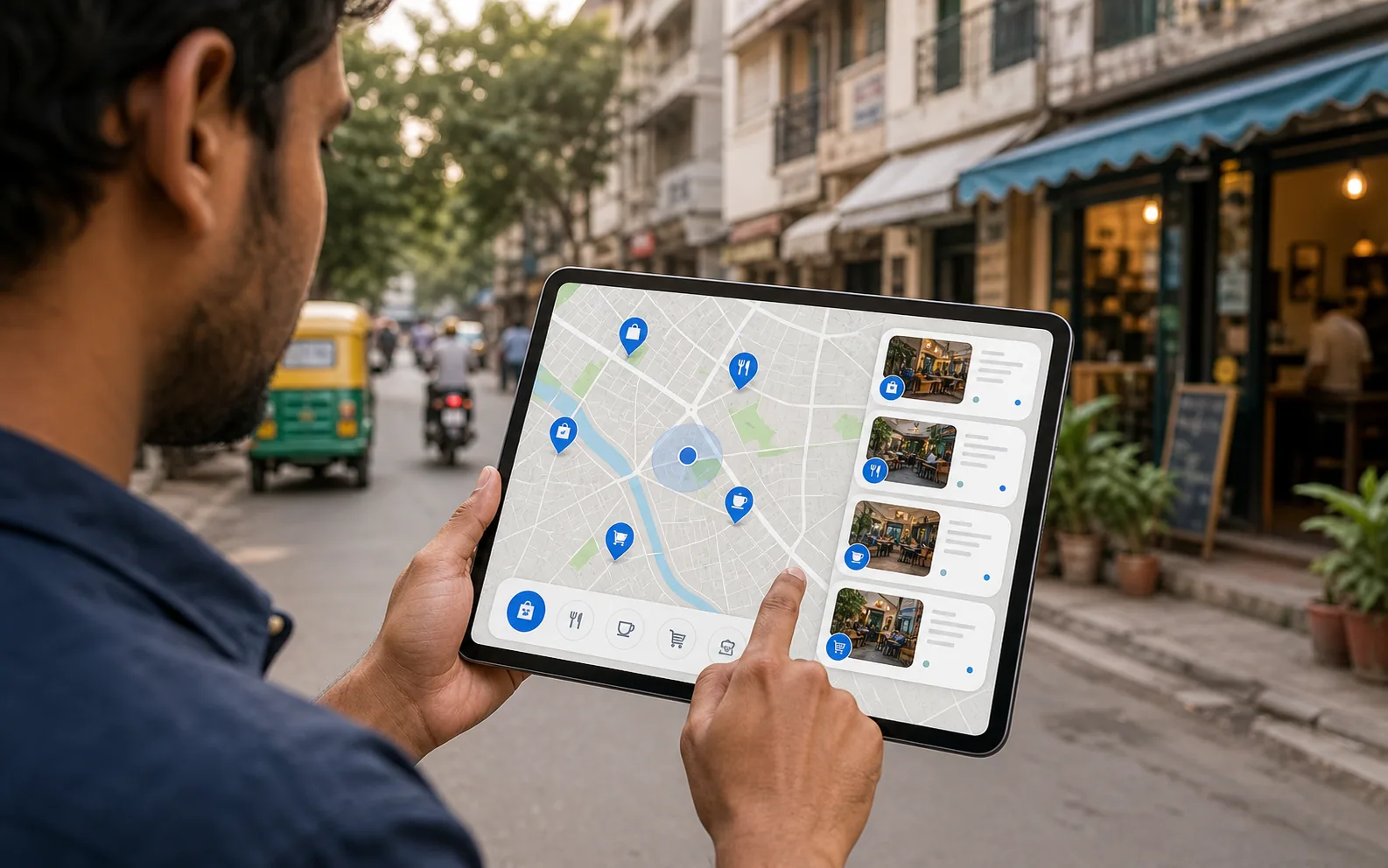
AI improves local discovery only when it helps a system understand a complicated request and explain a useful shortlist. It should not invent places, hide stale hours or turn popularity into a universal trust score. Location retrieval, opening-status checks and business records still need structured data and explicit rules.
A good system can interpret “a quiet vegetarian place open after 9 pm, under 25 minutes by metro, suitable for my grandfather” better than a literal keyword search. It must still show which requirements were met, what remains unknown and when the underlying facts were checked.
This article explains the product and data decisions behind that result. Consumers who need to assess a particular provider should use the guide to checking a local business before paying.
AI-powered local discovery must interpret the request first
Local queries mix several kinds of intent:
- need: meal, repair, shopping, event or another task;
- category: vegetarian restaurant, laptop repair, fabric market or wheelchair hire;
- location: current position, named area, route or destination;
- time: now, tonight, Sunday or a future date;
- constraints: budget, accessibility, retail quantity, delivery or invoice;
- preference: quiet, family-friendly, specialist, independent or familiar.
AI can translate natural language into these fields and ask a question when a missing answer would change the shortlist. “Near Connaught Place” may mean walking from the centre, driving within a radius or stopping along a route. The system should not guess silently.
Some terms are subjective. “Cheap,” “safe,” “authentic” and “best” require a definition or supporting evidence. A system can ask for a budget, report specific access information or show why a place is locally significant. It should not present an unsupported adjective as fact.
Retrieve plausible candidates before using AI to compare them
A language model should not recall nearby businesses from its training data and present them as current. Candidate places should come from maintained place records, approved data providers, merchant submissions or another accountable source.
The retrieval stage should establish stable identity where possible: place ID, name, coordinates, address or service area, category and business status. Duplicate profiles, relocated businesses and similarly named branches need entity resolution before ranking.
Google says Business Profile information can combine owner contributions, public web information, licensed data, user contributions and Google's own interactions with a place (how Google sources local information). A responsible product should preserve comparable source distinctions rather than flattening them into “the AI knows.”
Provider terms also matter. Google Places policies, for example, restrict storage of Places content and require appropriate attribution, while allowing place IDs to be stored under specified conditions (Places API policies). Product teams must design provenance, refresh and display rules around the data they are actually licensed to use.
Apply hard constraints before preference ranking
Do not let a high review score compensate for a failed requirement. If the user needs a pharmacy open now, a closed pharmacy should not rank first because it is popular. If step-free access is essential and access is unknown, the result should say so rather than assume suitability.
A useful pipeline separates:
| Decision layer | Example | Appropriate treatment |
|---|---|---|
| Hard eligibility | Required category, service area or current opening status | Filter when evidence is reliable; mark unknown when it is not |
| Practical fit | Travel time, stock confirmation, appointment or delivery | Calculate or verify for the intended time |
| Preference | Atmosphere, independent ownership or cuisine style | Rank with user control and an explanation |
| Trust evidence | Identity, recent corrections, relevant registration, review patterns | Display specific evidence; do not collapse into one badge |
| Commercial placement | Sponsored result or paid promotion | Label clearly and keep it from silently overriding requirements |
This prevents an opaque score from mixing incomparable things. It also makes correction easier: a wrong closing time can be fixed without reinterpreting every preference.

Rank by journey usefulness, not radius alone
Straight-line distance is cheap to calculate and often a poor proxy for effort. Bridges, one-way streets, traffic, metro connections, walking entrances and service areas can reverse the order of two places.
Route systems can return distance and duration for specific travel modes and departure conditions. Google's Routes documentation, for example, supports driving, walking, cycling, two-wheelers and transit, with traffic-aware options where available (Routes API).
The product should let the user choose or confirm the mode. An illustrative ranking might prefer:
- Place A: 2.5 km, 38 minutes by two buses;
- Place B: 6 km, 22 minutes by direct metro;
- Place C: 4 km, 18 minutes by car but no useful public-transport route.
There is no correct order without knowing the user's mode and constraints. “Nearest” should explain whether it means distance, current travel time or route position.
The same principle applies to the nearby-market workflow: a shortlist should reflect the trip the person can actually make.
Treat freshness as field-level evidence
A business profile is not simply current or stale. Its address might have been confirmed yesterday while its holiday hours came from an old website. Store source, observation date and confidence for fields that can change.
Opening status needs particular care. Google's current Places resource distinguishes regular hours, current hours, special days, temporary closure, permanent closure and future opening (Places resource). A local product should preserve these distinctions and use the place's timezone.
Useful freshness rules depend on the field:
- coordinates and legal identity change rarely but have high costs when wrong;
- regular hours change occasionally;
- special hours and events are date-bound;
- offers and stock can expire within hours;
- reviews remain historical evidence but may describe a previous owner or branch.
“Updated recently” is not enough if the system cannot say what was updated. When evidence conflicts, show the conflict or ask for confirmation. Do not let a model choose the most fluent source.

Use reviews carefully and keep trust explainable
Reviews can reveal patterns that structured fields miss: repeated delays, accessibility barriers, after-sales problems or a consistently helpful employee. They can also be manipulated, irrelevant to the requested service or concentrated in an earlier period.
AI summaries should preserve scope and disagreement. “Recent repair reviews often mention clear estimates; two describe delays in getting parts” is more useful than “Customers love this trusted shop.” The summary should link to the underlying reviews, identify the time period and avoid turning allegations into verified facts.
Google's Maps policy prohibits reviews that do not reflect genuine experiences, paid or incentivised ratings, multi-account manipulation and selective solicitation of positive reviews (Maps user-content policy). Detection can reduce obvious abuse, but no platform should promise that every remaining review is genuine.
Trust evidence should remain specific: identity matched, phone confirmed, owner-managed profile, registration checked, recent hours confirmation or transaction-linked review. Each label needs a definition, source and date. None proves overall quality.
Explain why each result appears
An explanation should help the user verify or change the result. “Recommended for you” explains nothing. A useful card might say:
Matches vegetarian dining and step-free entrance; 24 minutes by metro at the requested time; current hours supplied by the owner three days ago; quietness inferred from six recent reviews and not independently verified.
This illustrative explanation separates facts from inference and exposes uncertainty. The user can decide whether quietness matters enough to inspect the reviews.
Show which filters were applied, which preference moved a result higher and why a candidate was excluded. Let users change distance, travel mode, open status and other important controls. Sponsored placement must be unmistakable and should not masquerade as personal relevance.
Ranking quality should be tested against the reader's task, not only clicks. Measure whether suitable candidates are retrieved, hard constraints are respected, corrections propagate, explanations match actual ranking inputs and different neighbourhoods receive adequate coverage. A click can reflect curiosity or misleading placement; it is not proof of a good recommendation.

Give businesses and users a correction route
Local data decays. Businesses move, phone numbers change, holiday hours end and duplicate profiles appear. A discovery product needs correction as a core workflow, not a contact form nobody owns.
Owners should be able to claim a profile through proportionate verification, see the source and status of important fields, propose changes and challenge a rejected correction. Users should be able to report a closed place, wrong pin or misleading category without gaining unrestricted control of the profile.
Google similarly allows verified owners to edit Business Profiles and other users to suggest edits (Business Profile editing). A separate product needs its own evidence, moderation and appeals policy; copying the visible result does not copy the underlying assurance process.
Record significant changes and retain enough history to investigate abuse. High-impact edits—bank details, identity, location or ownership—deserve stronger review than a menu description. Inform the owner when a consequential field changes.
Limit location collection and model authority
Ask only for the location precision needed for the task. A neighbourhood or landmark may be enough for browsing; precise live location may be justified for walking directions. Explain the benefit, offer manual entry and let the user revoke or clear saved locations.
Do not infer sensitive traits or habitual locations merely because location history makes it possible. Separate one-time search context from a persistent profile, set retention limits and protect raw coordinates from unnecessary staff, advertising and model access.
Treat merchant descriptions, websites and reviews as untrusted input. Text can contain false claims or instructions aimed at a model. The model must not follow listing text as system instructions, expose other users' data, change ranking policy or call tools without permission. Extract claims into controlled fields, restrict tool access and keep consequential changes behind verification.
AI should also abstain. When there are too few relevant candidates, unresolved location ambiguity or stale opening data, say “no reliable match” and offer a broader search or manual check. Inventing a confident recommendation is not graceful failure.
What GoBazaar currently demonstrates—and does not prove
AiRedHQ's documented GoBazaar private-beta interface is designed around an interactive map, structured market and place profiles, discovery categories, dated offers and events, and merchant-managed context (GoBazaar product page). Its interface also distinguishes intended ideas such as location integrity, current information and visible verification.
That is first-party product evidence about what has been designed and built at private-beta level. It is not evidence of ranking accuracy, information freshness, merchant adoption, verification success or customer outcomes. The place names, counts, offers and performance figures in the product demonstration are explicitly illustrative.
The most useful product direction is therefore not “add more AI.” It is to make the evidence chain visible: understand the request, retrieve real candidates, apply hard constraints, calculate the actual journey, rank preferences, show sources and uncertainty, and make corrections work.
AI earns a role in local discovery when it reduces the work of expressing a need without weakening the facts beneath the answer. If a simpler filter and map can answer the query more reliably, use them.

Built from product experience