Key takeaways
- Udhaar is a loan to your customer. Decide who gets it, the limit and the due date before you give it, not after.
- Record every credit sale against a bill, and every payment against the bills it settles. A running total alone hides which money is late.
- Review an ageing view weekly: what is current, 1-30, 31-60, 61-90 and 90+ days overdue. Old dues are the ones you lose.
- Remind early, politely and with the exact amount and bill. Stop new credit for customers whose old dues keep growing.
Credit keeps customers loyal in many Indian neighbourhoods. A kirana, medical store, hardware shop or tailor that refuses all udhaar can lose regulars to the shop next door. The problem is rarely giving credit. It is losing track: a notebook page that is hard to read, a balance nobody agrees on, and dues that quietly become too old to collect.
This guide covers simple rules that work whether you use a notebook, a spreadsheet or software.
Decide your credit rules before the next request
Most credit losses start with an unplanned "yes" at a busy counter. Write three rules and apply them to everyone:
| Rule | A workable starting point |
|---|---|
| Who gets credit | Regular customers you can contact, known for some months, with a working phone number |
| How much | A limit per customer, for example one week's typical purchases. Above it, partial payment first |
| By when | A due date for every credit sale, for example 15 or 30 days, or the customer's salary date |
These figures are illustrative; pick ones that fit your margins. A shop that earns ₹8 on a ₹100 sale cannot afford to wait three months for ₹5,000, because that amount is tied up instead of buying new stock.
Tell customers the rule once, in a friendly way: "Credit is up to ₹2,000, settled by the 5th." It is far easier to apply a known rule than to argue about a vague one later.
Record every credit sale against a bill
A running total ("Sharma ji: ₹3,450") is the most common udhaar record and the hardest to manage. When the customer disputes it, you cannot show what it is made of, and you cannot tell which part is two days old and which part is two months old.
Record each credit sale as its own entry:
- date;
- bill or invoice number;
- items or a short description;
- total amount;
- due date.
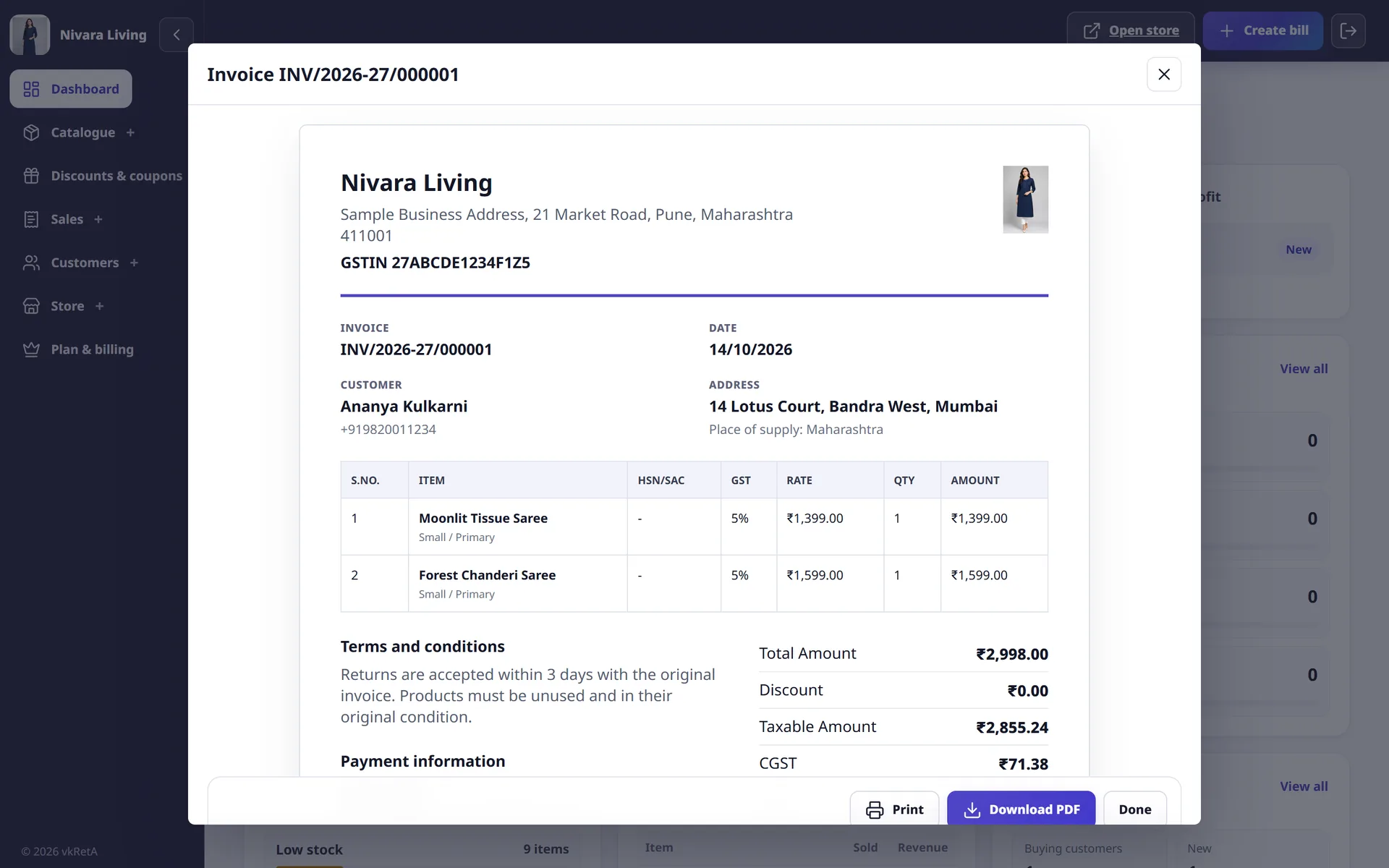
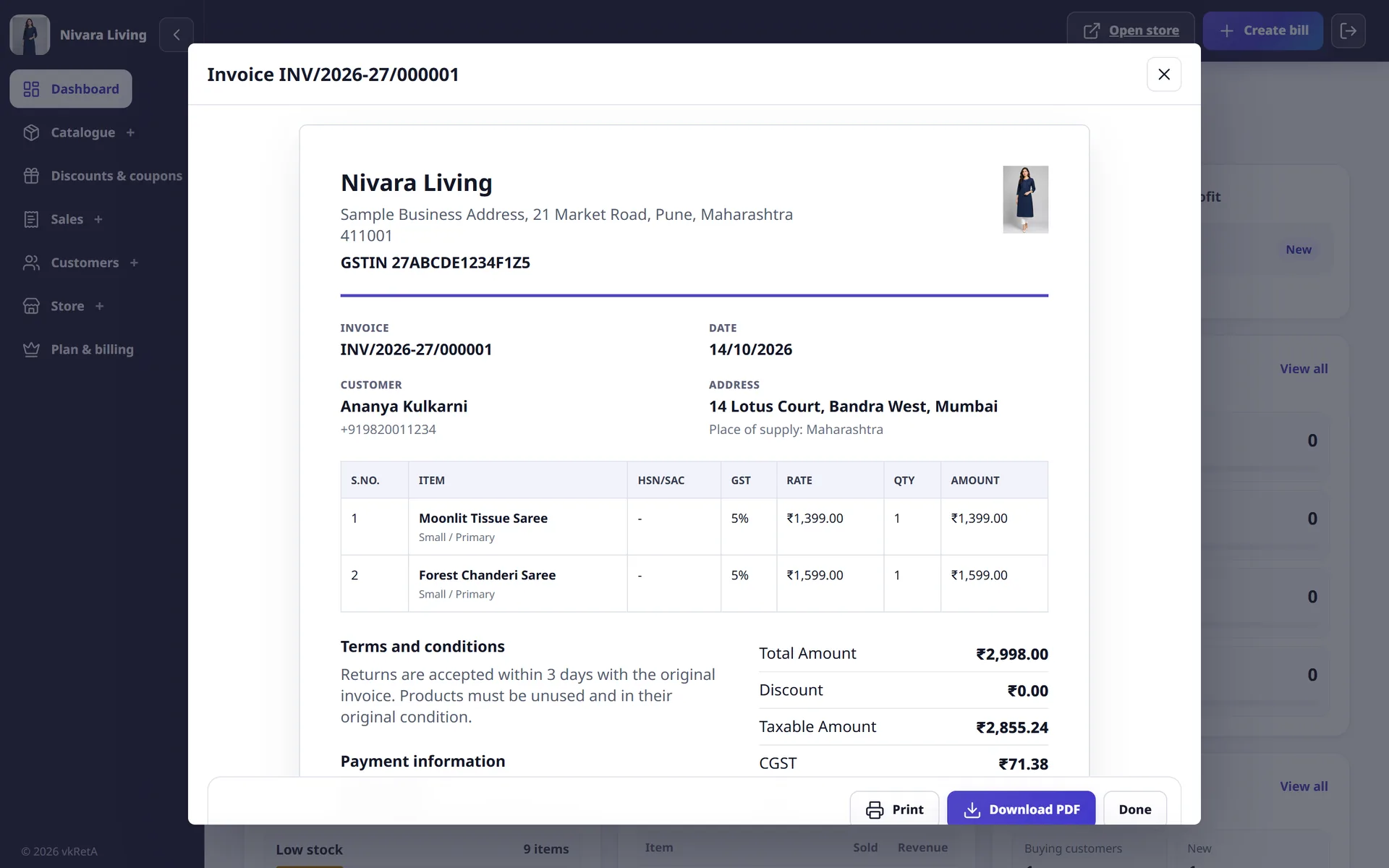
If you issue bills, the bill number links the ledger to the sale. A customer who questions a balance can be shown the three bills that make it up. That conversation is short and rarely angry.
Record payments against the bills they settle
When a customer pays, write down the date, amount and method: cash, UPI, bank transfer, card or cheque. Then decide which bills the payment settles. The usual practice is oldest first, which keeps the oldest dues from lingering.
Illustrative example. A customer owes three bills: ₹1,200 (due 5 September), ₹800 (due 20 September) and ₹1,500 (due 5 October). On 8 October they pay ₹1,500 by UPI.
| Bill | Amount | Paid | Balance | Status |
|---|---|---|---|---|
| Bill 1, due 5 Sep | ₹1,200 | ₹1,200 | ₹0 | Paid |
| Bill 2, due 20 Sep | ₹800 | ₹300 | ₹500 | Partly paid, overdue |
| Bill 3, due 5 Oct | ₹1,500 | ₹0 | ₹1,500 | Overdue |
The total due is ₹2,000 either way, but the table shows something the running total hides: ₹500 has been overdue since 20 September. That is the amount to raise first.
Give a receipt or message for every payment, and record UPI references. When there is a dispute, a payment with a reference number settles it in seconds.
Read the ageing view every week
An ageing view groups unpaid balances by how long they have been overdue. It is the single most useful report for a shop that gives credit.
| Bucket | What it usually means | Sensible action |
|---|---|---|
| Not yet due | Normal credit | Nothing; remind a day before the due date if you like |
| 1-30 days overdue | Customer forgot or is short this month | A polite reminder with the amount and bill |
| 31-60 days | Pattern forming | Personal conversation; pause new credit until partly paid |
| 61-90 days | At risk | Agree a written payment plan with dates |
| 90+ days | Likely loss | Stop credit; decide whether to pursue or write off |
Spend ten minutes each week on this view. Two habits matter most:
- Chase the oldest money first. A ₹600 balance that is 70 days overdue is more urgent than ₹3,000 that is five days overdue.
- Watch customers whose total grows every month, even if each bill is small. A growing balance with small, irregular payments is the earliest warning sign.
Remind politely, with the exact amount
Many customers simply forget. A clear reminder solves most cases without damaging the relationship:
"Namaste, this is a reminder from Shree Ganesh Stores. ₹500 is pending against bill 2 from 20 September, and ₹1,500 against bill 3 due 5 October. You can pay at the shop or by UPI. Thank you."
This message is illustrative. It works because it is specific, gives the bill numbers and offers a simple way to pay. Avoid public reminders, group messages or anything a customer could find humiliating. Collection by threat or harassment is not only bad business; it can expose you to legal trouble.
Send reminders at a fixed point, for example one day after the due date and again after two weeks, so it feels like routine rather than a personal accusation.
Paper, spreadsheet or software
Any method works if it records bills, due dates and payments separately. The question is how much effort it takes to keep it right.
| Method | Works well when | Breaks down when |
|---|---|---|
| Notebook | Few credit customers, one person at the counter | Several staff, disputes, more than 20 active accounts |
| Spreadsheet | Owner is comfortable with formulas and updates daily | Entries are made from memory at night; no link to bills |
| Billing software with a ledger | Credit sales are billed in the same system | Staff skip billing for "small" credit sales |
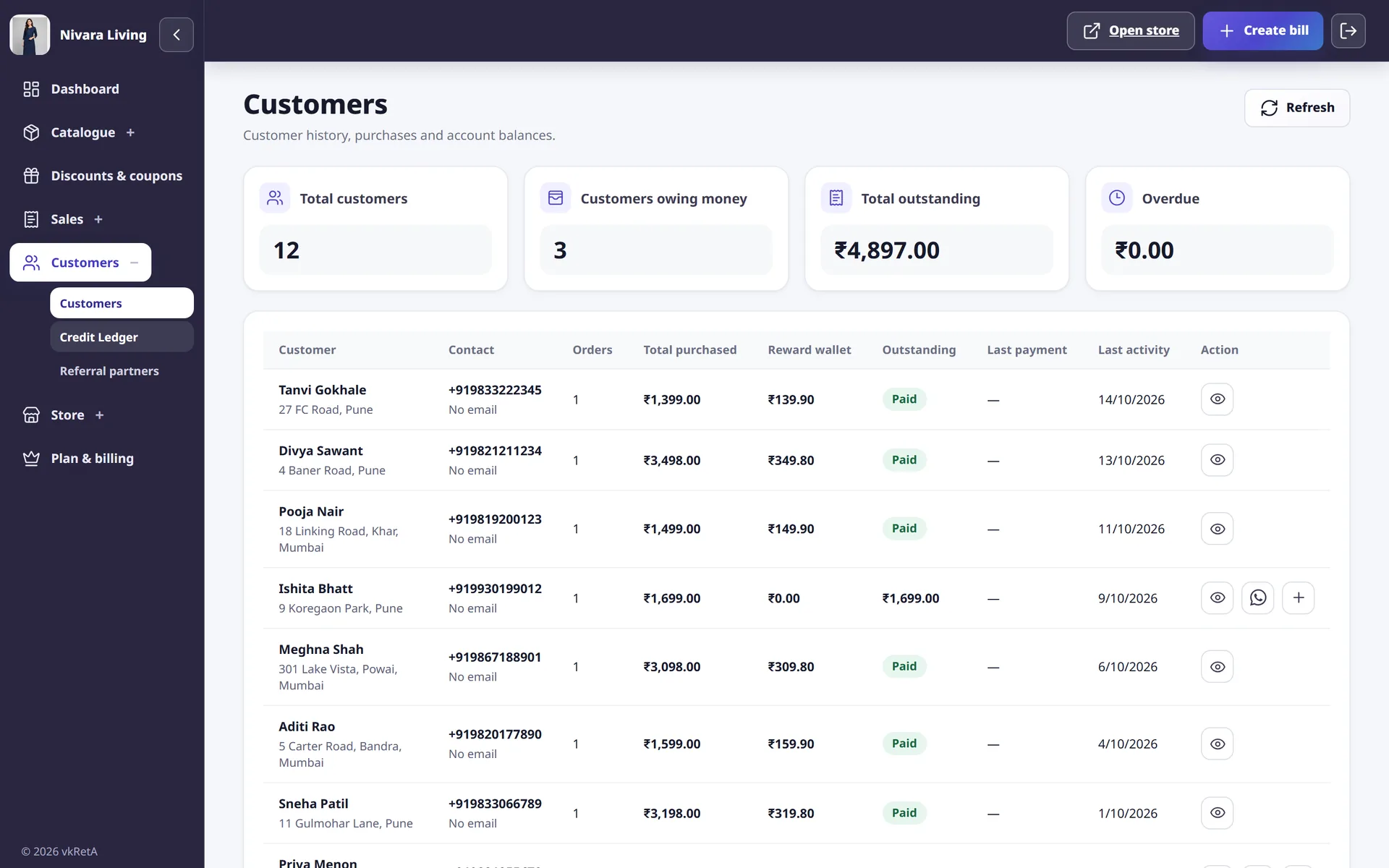
vkRetA, from AiRedHQ, links the customer ledger to the bills you issue. Each customer's invoices carry due dates and balances, payments can be recorded by method (cash, UPI, bank transfer, card, cheque) and allocated across invoices oldest first, and overdue amounts are grouped into the same 1-30, 31-60, 61-90 and 90+ day buckets described above. From a customer's record you can open a WhatsApp reminder with the pending amount already written. Check vkreta.in for which ledger features are included in each plan.
When to stop giving credit
Credit is a tool for keeping good customers; a sale you never collect is a loss. Pause new udhaar when:
- a customer is over their limit and has not paid anything in 30 days;
- any balance passes 60 days overdue without an agreed plan;
- the customer avoids calls or disputes bills that are clearly recorded;
- your own total outstanding credit is larger than you could afford to lose this year.
Stopping new credit does not have to end the relationship. "Let us clear the old bills first, then we will restart credit" is a fair and common message. Customers who value the shop usually respect a rule that is applied consistently. Those who do not were costing you money.