Key takeaways
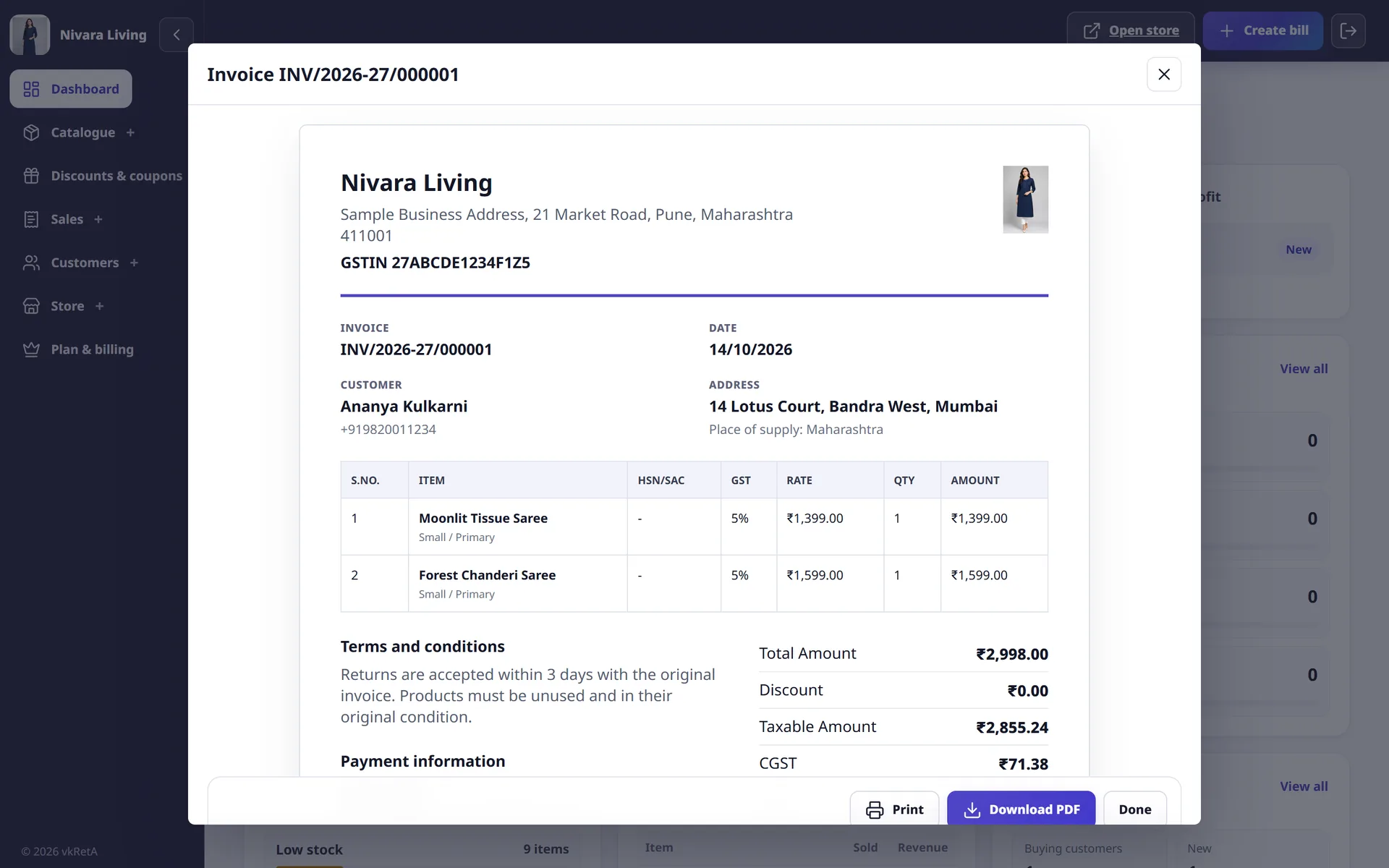
- A GST tax invoice must carry the particulars listed in Rule 46 of the CGST Rules, 2017, including your GSTIN, a unique serial number, the date, HSN or SAC codes, taxable value, tax rate and tax amount.
- Invoice numbers must be consecutive, at most 16 characters, and unique for the financial year. Start a fresh series every 1 April.
- Place of supply decides the tax: a sale within your state carries CGST plus SGST; a sale to another state carries IGST.
- Composition taxpayers and sellers of exempt supplies issue a bill of supply, not a tax invoice, and must not charge GST on it.
- Never edit an issued invoice. Correct it through a credit or debit note, and ask a chartered accountant when a case is unclear.
A GST invoice is a legal document: your customer may claim input tax credit on it, your returns are built from it, and a missing particular can cause problems when you file GSTR-1 or generate an e-way bill. Here is what a small registered business needs on every bill, based on the official rules.
What a tax invoice must contain
Rule 46 of the CGST Rules, 2017 lists the particulars of a tax invoice. CBIC's invoice rules summary sets them out in full. In plain terms:
| Particular | What it means in practice |
|---|---|
| Supplier name, address and GSTIN | Your registered business details, exactly as on your GST registration |
| Invoice serial number | Consecutive, unique for the financial year (see the next section) |
| Date of issue | The date the invoice is issued |
| Recipient name, address and GSTIN or UIN | Required when the buyer is registered |
| Recipient and delivery address, with state name and code | Required for an unregistered buyer when the taxable value is ₹50,000 or more |
| HSN code for goods, or SAC for services | The classification code for each line (see below) |
| Description | What was supplied, in words the buyer can recognise |
| Quantity and unit | For goods, for example "2 PCS" or "1.5 KGS" |
| Total value | The value of the supply |
| Taxable value | The value after any discount or abatement, on which tax is calculated |
| Rate and amount of tax | Separately for CGST, SGST or UTGST, IGST and cess, as applicable |
| Place of supply, with state name | Required for inter-state supplies |
| Delivery address | When it is different from the place of supply |
| Reverse charge | Whether tax is payable on reverse charge |
| Signature | Signature or digital signature of the supplier or an authorised representative |
Billing software prints these fields only if your business details, customer details and item codes are filled in correctly.
Invoice numbering: consecutive, short and unique each year
Rule 46(b) requires a consecutive serial number of not more than 16 characters, in one or multiple series. It can use letters, numerals, hyphens and slashes, and must be unique for the financial year.
That allows practical formats such as INV/25-26/0001 (14 characters) or separate series for different counters or branches, such as A-0001 and B-0001. What it does not allow:
- Skipping numbers or reusing a cancelled invoice number for a new sale.
- Restarting a series in the middle of the financial year.
- Carrying the same series into the next financial year. Start a new series every 1 April; GSTN advised taxpayers to do this from the 2019-20 financial year onwards.
If you cancel an invoice, keep it in the series and mark it cancelled. An unexplained gap is exactly what a tax officer will ask about.
HSN and SAC codes: how many digits
Goods are classified by HSN (Harmonised System of Nomenclature) codes and services by SAC (Services Accounting Code). Notification 78/2020-Central Tax, dated 15 October 2020 and effective from 1 April 2021, set the minimum number of digits by turnover in the previous financial year:
| Aggregate turnover in the previous year | Minimum HSN/SAC digits on the invoice |
|---|---|
| Up to ₹5 crore | 4 digits; may be omitted on invoices to unregistered buyers (B2C) |
| More than ₹5 crore | 6 digits |
Using more digits than the minimum is allowed. The GST portal's HSN search helps you find the right code. Store the code once against each product or service so you never type it at the counter.
Place of supply: CGST plus SGST, or IGST
GST is a destination-based tax. Which taxes appear on the bill depends on whether your location and the place of supply are in the same state:
| Situation | Place of supply (general rule) | Tax on the invoice |
|---|---|---|
| Customer buys at your counter | Your shop's location | CGST + SGST (or UTGST) |
| You deliver goods within your state | The delivery location in your state | CGST + SGST |
| You deliver goods to a customer in another state | The delivery location in the other state | IGST |
| Service performed at your premises, such as a haircut | Where the service is performed | CGST + SGST |
| B2B sale to a registered buyer in another state | Generally the buyer's location | IGST |
The place-of-supply rules are in the IGST Act, 2017, with special cases for services such as events, transport and online services. If you sell across state lines regularly, have a chartered accountant confirm your setup once: charging CGST and SGST where IGST was due can mean paying the correct tax again. On inter-state invoices, print the place of supply with the state name.
Bill of supply, timing and corrections
Bill of supply. Under Rule 49, composition taxpayers and businesses supplying exempt goods or services issue a bill of supply instead of a tax invoice. It shows no GST, and a composition taxpayer must state on it that they are not eligible to collect tax on supplies. A business that is not registered cannot charge GST or show a GSTIN.
When to issue. For goods, issue the invoice before or at the time of removal or delivery. For services, the CBIC summary gives 30 days from the date of supply (45 days for banks, insurers and similar financial institutions).
E-invoicing. Since 1 August 2023, under Notification 10/2023-Central Tax, businesses whose aggregate turnover exceeded ₹5 crore in any financial year from 2017-18 must generate e-invoices with an IRN for B2B supplies. Most small shops are below this threshold, but check it as your turnover grows.
Corrections. Once issued, an invoice should not be edited. Errors in value or tax are corrected through a credit note or debit note under Section 34 of the CGST Act and reported in your returns. If your billing tool cannot issue credit notes, cancel and re-issue only within the rules your accountant agrees, and keep the cancelled invoice in your series.
Rates. GST rates were rationalised with effect from 22 September 2025, and many items and services moved between slabs. Check the current rate for each product and service on the CBIC tax information portal rather than relying on an old price list.
Setting up your billing tool
A one-time setup prevents most invoice errors:
- Enter your legal name, address, state and GSTIN exactly as registered.
- Choose an invoice prefix and confirm the numbering restarts each financial year.
- Add an HSN or SAC code and GST rate to every product and service.
- Save registered customers with their GSTIN and state, so inter-state bills pick up IGST.
- Print a sample invoice for an intra-state sale and an inter-state sale, and check every row of the table above.
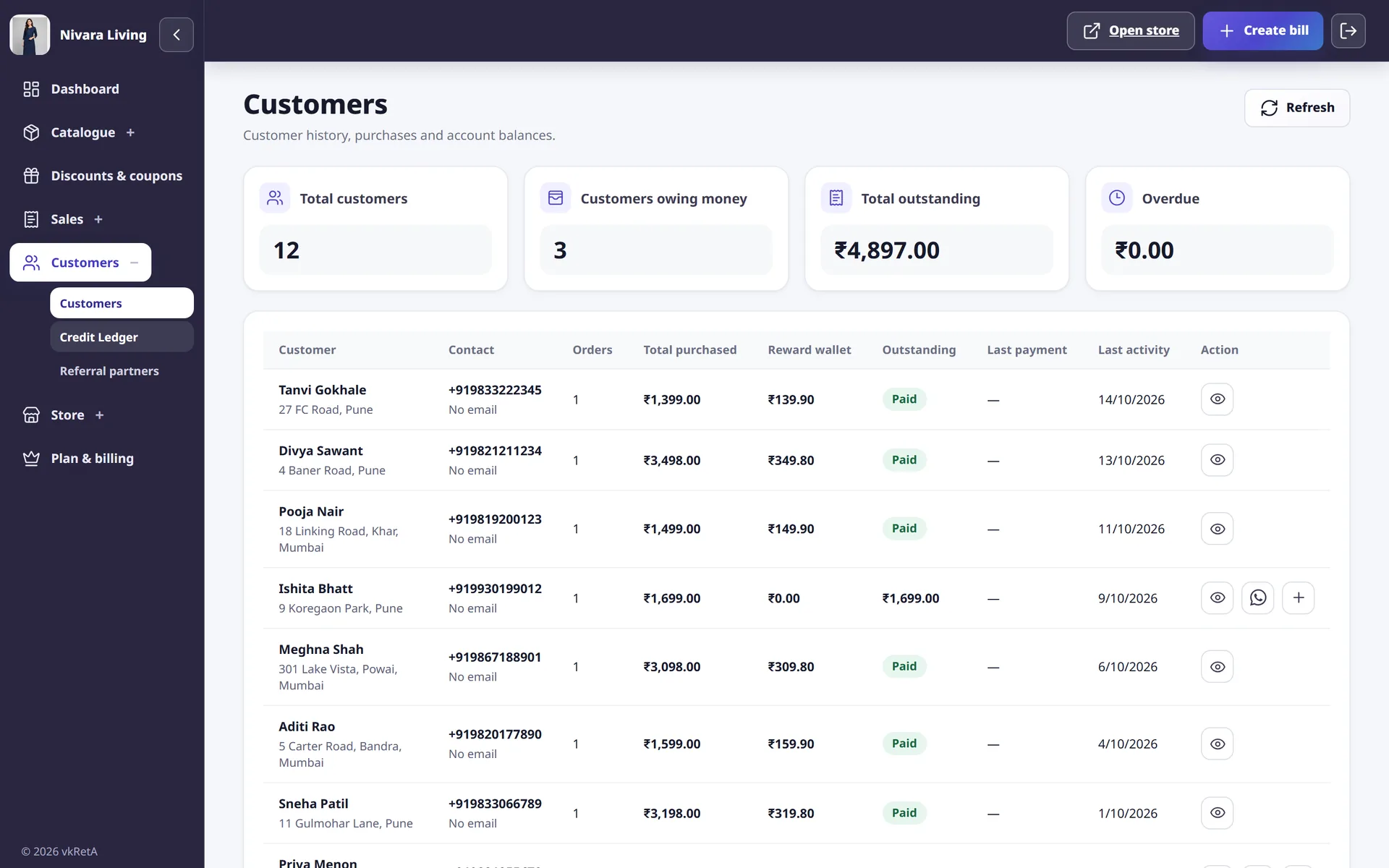
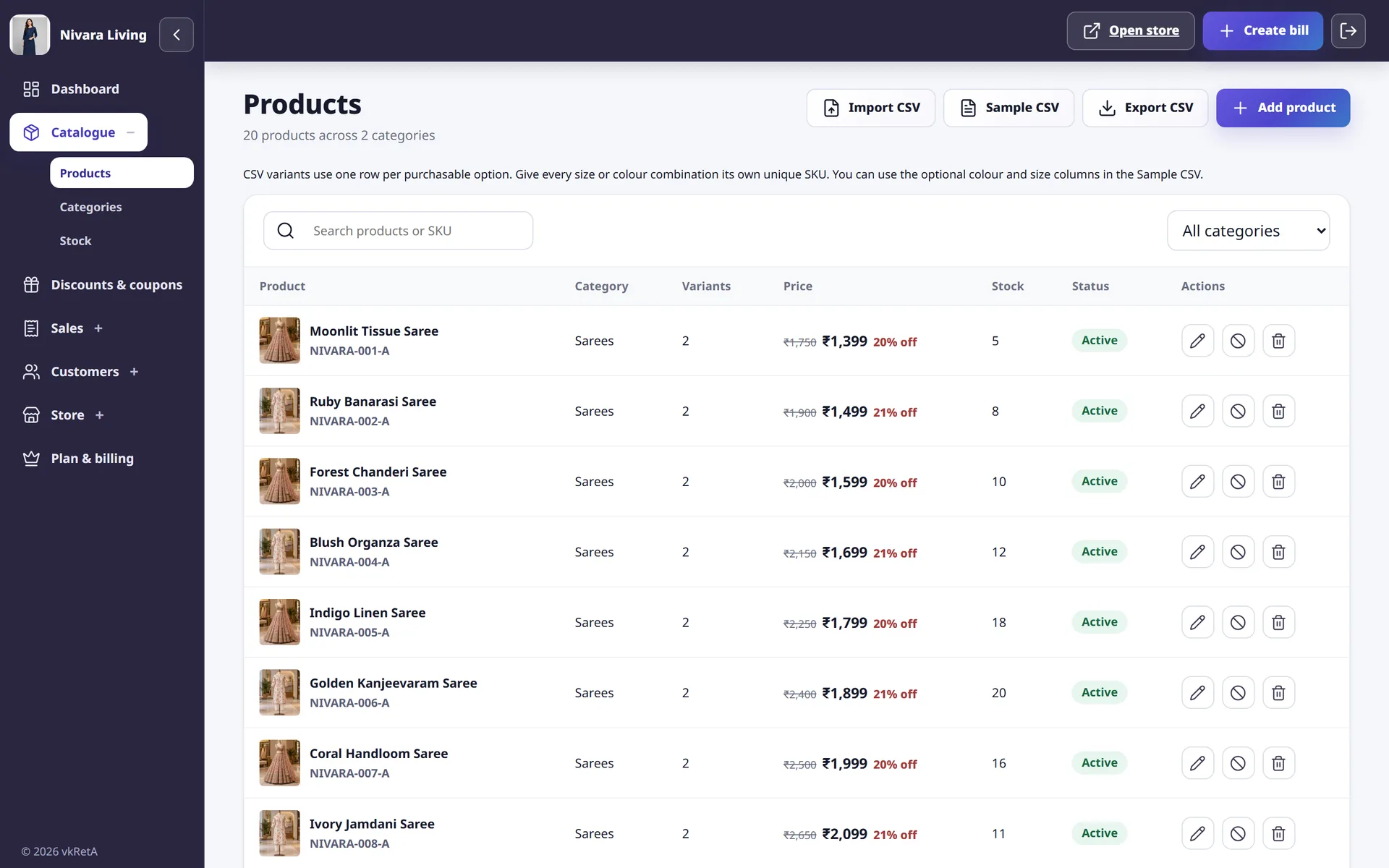
In vkRetA, GST can be turned on or off per business, bills support CGST/SGST or IGST, invoice numbers are sequential, and invoices are generated as PDFs. The merchant chooses the GST rate for each product and service, and the rate suggestions in the app say to confirm with a CA. Responsibility for the correct rate and treatment stays with the business, whichever software you use.
Sources
- CBIC, Invoice rules under GST (Rule 46 particulars, bill of supply, time limits)
- CBIC, Tax information portal (current GST rate notifications)
- GST portal, Search HSN or SAC code
- Notification 78/2020-Central Tax, 15 October 2020 (HSN digits by turnover)
- Notification 10/2023-Central Tax, 10 May 2023, published by the GST Council (e-invoicing threshold of ₹5 crore)
Facts checked on 14 October 2026. Tax rules change; confirm current requirements with a qualified professional before relying on them.