

A personal financial plan is not a list of products to buy. It is a set of decisions about what your money must do, when it must be available and which risks could derail it. Start with one page: your goals, monthly surplus, assets, debts, protection gaps and the next action for each priority.
A plan is useful only when it changes what happens next month. A spreadsheet with forty assumptions but no standing instruction, debt payment or insurance review is still unfinished. Equally, investing first and working out the goal later can leave short-term money exposed to losses at the wrong time.
This guide is educational, not personalised investment, tax, insurance or legal advice. Returns are not guaranteed, and product, tax and regulatory rules change. Use current official information and qualified advice when a decision depends on your circumstances.
Start your personal financial plan with a one-page snapshot
Do not begin by estimating distant returns. Begin with facts you can verify today.
| What to record | A useful level of detail |
|---|---|
| Monthly take-home income | Stable income separately from bonuses, commissions or irregular work |
| Essential spending | Housing, food, utilities, transport, healthcare, school fees and minimum debt payments |
| Flexible spending | Costs that can be reduced without missing a legal or financial obligation |
| Assets | Cash, deposits, investments, retirement balances and property, with current values where available |
| Debts | Outstanding balance, interest rate, minimum payment and any prepayment charge |
| Protection | Health and life cover, deductibles, exclusions, dependants and employer-linked benefits |
| Near-term changes | A move, career break, new dependant, loan reset or large known expense |
Calculate two numbers:
- Monthly surplus = reliable take-home income − total monthly outflow. Use a conservative income figure when earnings vary.
- Net worth = assets − liabilities. This is a position statement, not a score of personal success.
Reconcile the figures with recent bank, card, loan and investment statements. If the budget says ₹20,000 should remain each month but the account balance does not rise, find the leak before committing that ₹20,000 to a goal.
Turn wishes into dated, costed goals
“Save more” cannot guide a decision. “Build ₹3 lakh of emergency savings by June 2027” can. Give each goal four fields: purpose, target date, estimated amount at that date and priority.
Inflation matters when today’s price is not the price you will eventually pay. A simple illustration is:
Future cost = today’s cost × (1 + assumed inflation rate)^years
The inflation rate is an assumption, not a fact. Education, healthcare and housing costs may behave differently from general consumer inflation, so test more than one rate when the goal is important.
Then sort goals by consequence:
- Prevent immediate harm: essential bills, minimum debt payments and necessary insurance.
- Build resilience: a starter cash buffer, then an appropriate emergency reserve.
- Fund time-bound commitments: fees, a move, replacement equipment or other planned costs.
- Build long-term options: retirement and other goals that can tolerate market uncertainty.
Two goals with the same date may still need different treatment. A child’s first-year tuition is less flexible than a discretionary vehicle upgrade. Priority should reflect what happens if the target is missed, not which goal sounds most exciting.
Stabilise cash flow before taking investment risk
An investment plan built on an unreliable monthly surplus will be repeatedly stopped or redeemed. First make the cash flow workable: automate essential payments, reduce avoidable high-cost borrowing and create room for irregular annual expenses.
Keep predictable costs out of the emergency category. Annual insurance premiums, routine vehicle servicing and known school expenses belong in separate sinking funds. An emergency reserve is for disruptions that are both necessary and hard to schedule, such as income loss or urgent treatment.
The right reserve is not automatically six months for everyone. It depends on income stability, dependants, insurance gaps, access to other reliable income and how quickly expenses could be reduced. The Reserve Bank of India’s financial-education material uses at least three months of living expenses as a general starting point and says people with less secure income may need more. The practical decision method is in our emergency fund calculator guide.
Keep this money accessible. Chasing a higher return can defeat its purpose if withdrawal is slow, the value can fall, or an exit charge applies exactly when cash is needed.
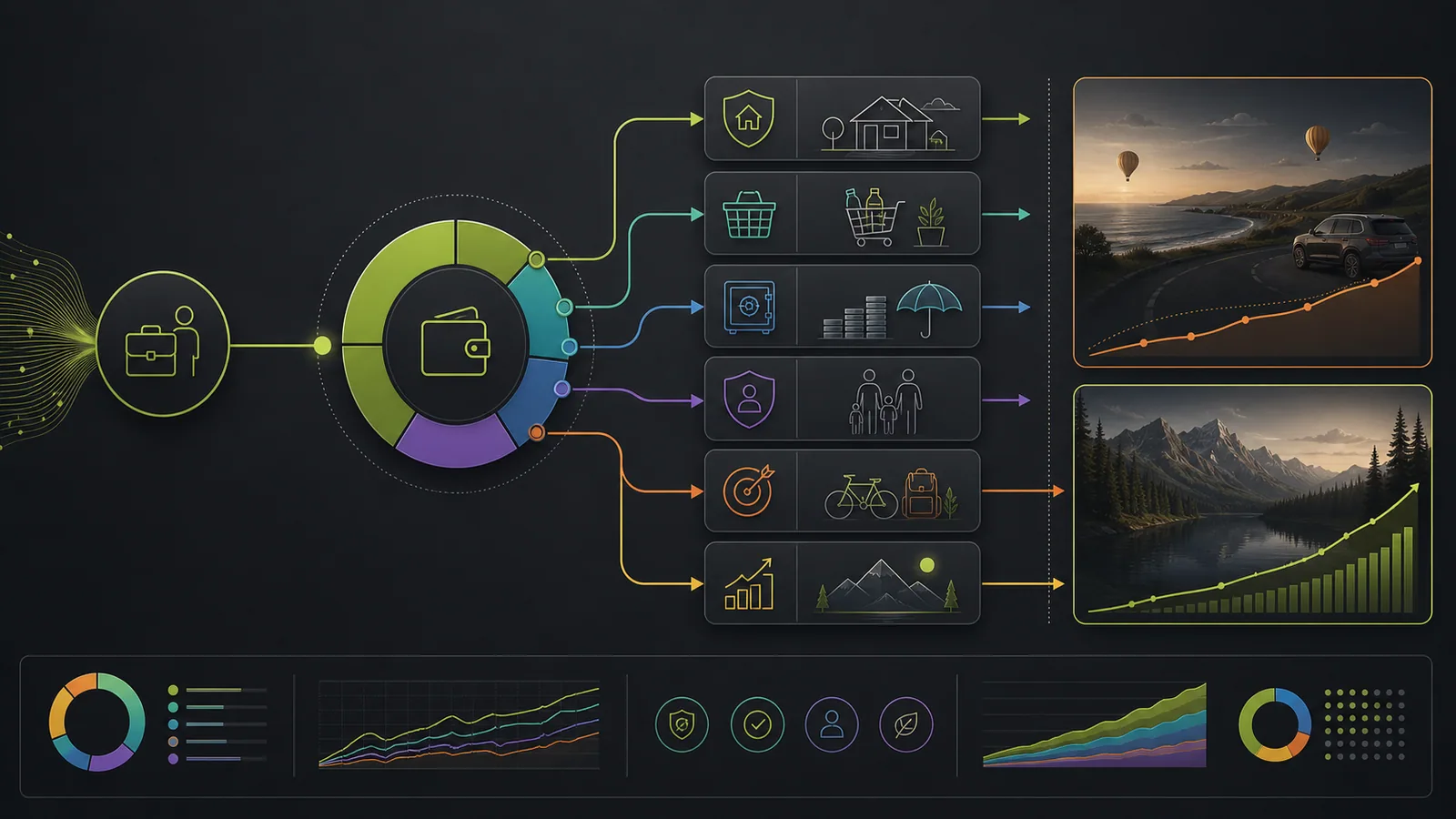
Decide the order of debt, insurance and investing
There is no universal sequence for every rupee, but the following order prevents common planning failures:
- Make required payments and avoid penalties.
- Create a small immediate buffer so the next surprise does not return to a credit card.
- Address expensive debt, comparing the guaranteed interest saved with realistic after-cost investment outcomes.
- Protect risks that could overwhelm the plan, especially major health costs and loss of an income on which dependants rely.
- Build the full emergency reserve.
- Invest for goals according to their time horizon and acceptable risk.
Insurance and investing solve different problems. Insurance transfers a defined risk; investing builds assets while accepting uncertainty. Check policy wording, exclusions, waiting periods, deductibles and renewal conditions rather than choosing only by premium or a simple income multiple.
Debt also needs context. Paying down a very costly revolving balance will often be more urgent than adding discretionary investment risk. A low-rate secured loan may require a closer comparison because liquidity, tax treatment, prepayment terms and personal comfort can affect the choice. Do not use an assumed market return as though it were guaranteed.
Match each goal to its time horizon and risk
Risk tolerance is how comfortable you feel with uncertainty. Risk capacity is how much loss or delay the goal can actually absorb. The second matters even when the first is high.
| Goal condition | Planning implication |
|---|---|
| Money is needed soon and the date is fixed | Prioritise access and capital stability over return-seeking |
| Date is flexible but amount is important | Some risk may be manageable if the plan can wait or contributions can rise |
| Horizon is long and interim falls are affordable | Growth assets may be considered within a diversified plan |
| A loss would threaten essentials | Reduce risk regardless of confidence or recent market performance |
SEBI requires mutual-fund schemes to display a Riskometer ranging from low to very high risk. It is a useful product-risk signal, but it does not decide whether the product fits your goal. Read the current scheme documents, costs, liquidity conditions and portfolio information as well (SEBI’s Riskometer guide).
Diversification reduces dependence on one asset, issuer or market outcome; it does not remove risk. Avoid creating a complicated collection of products that you cannot explain, monitor or rebalance.

Calculate the contribution each goal requires
For each goal, calculate the future target, subtract assets already dedicated to it, then estimate the contribution needed under several scenarios.
Suppose a goal is estimated at ₹12 lakh in eight years and ₹2 lakh is already set aside. The plan must answer how the ₹10 lakh gap could be closed—not merely project what an arbitrary ₹5,000 monthly investment might become. Test a cautious, central and stronger-return scenario, and label all three as illustrations.
If the required monthly total is greater than the available surplus, the plan is not a failure; it has exposed a trade-off. You can:
- extend a flexible deadline;
- reduce a flexible target;
- increase income or redirect spending;
- use an existing asset where appropriate; or
- change priority between goals.
Do not “solve” an unaffordable goal by entering an optimistic return. Our SIP calculator guide explains how to work backwards from a goal and test the assumptions behind a monthly contribution.
Treat retirement as a separate long-term plan
Retirement should not be whatever remains after nearer goals. It involves a long accumulation period followed by an uncertain period of withdrawals, inflation, healthcare costs and possible support for family members.
Estimate retirement spending in today’s money, translate it to the retirement date, subtract reliable income sources and test how long the remaining assets may need to last. Keep assumptions about inflation, returns and longevity visible. Employer benefits, EPF, NPS, property or a pension can be part of the picture, but avoid counting an asset twice or treating a market-linked balance as guaranteed income.
The retirement planning guide for India walks through that calculation. NPS is a regulated defined-contribution pension system, so its outcome depends on contributions, investment performance and the rules that apply; consult current PFRDA material rather than relying on an old summary (PFRDA overview of NPS).

Convert the plan into a short action list
A practical plan ends with owners, dates and amounts. For example:
| Action | Amount or decision | Due date | Evidence of completion |
|---|---|---|---|
| Create starter buffer | ₹25,000 | 30 September | Separate savings balance |
| Review health cover | Compare exclusions and deductible | 15 October | Policy summary saved |
| Increase debt payment | Additional ₹8,000 monthly | Next salary date | Standing instruction active |
| Start goal contribution | ₹12,000 monthly | After buffer is complete | First contribution recorded |
| Update nominations | Relevant accounts | 30 November | Confirmations stored |
Automation helps with consistency, but it is not a substitute for review. Store policy documents, loan terms, nominations and account details securely, and make sure a trusted person knows how essential records can be found in an emergency. Never share passwords, PINs or OTPs.
Review the plan when life changes—not only once a year
A short monthly check should confirm that bills are covered, the planned surplus exists and automated contributions were completed. A fuller annual review can update goal costs, balances, insurance needs, nominees, asset mix and assumptions.
Review sooner after a job change, income shock, marriage, separation, birth, major illness, inheritance, new loan or material regulatory change. Rebalancing should restore the intended level of risk; it should not become a reason to trade on every market move.
Seek qualified help when the consequences are hard to reverse, the rules are complex or different interests must be balanced. For personalised securities advice, verify the adviser’s registration and understand fees, conflicts and scope; SEBI explains what registered investment advisers do and provides links for checking registration (SEBI investor guidance on investment advisers).
The strongest personal financial plan is rarely the most elaborate. It is the one that protects essentials, gives every important goal a realistic claim on cash flow and makes the next decision obvious. If circumstances change, update the plan; do not hide the change behind a more optimistic forecast.
Sources

Built from product experience